Korea’s Living Museum
Have you ever wanted to walk through streets where ancient kings once ruled for over 1,000 years, creating one of world’s longest-lasting dynasties? Where UNESCO recognizes not just individual monuments but an entire city as living testament to sophisticated civilization that predates most European kingdoms? Where you can climb inside actual royal tombs containing treasures that prove Korean trade networks reached Mediterranean world over 1,400 years ago? Where Buddhist temples demonstrate architectural perfection and spiritual philosophy that influenced all of East Asian Buddhism? Where astronomical observatories built by 7th-century queens show scientific knowledge that wouldn’t reach Europe for centuries?
Gyeongju Historic Areas (경주역사유적지구) offers exactly this experience – but only if you understand what makes this ancient capital unique among world heritage sites, why Silla Dynasty civilization produced artistic and technological achievements rivaling Tang China and Nara Japan, how to visit the five designated UNESCO areas representing different aspects of Korean cultural development, and what historical contexts transform simple stone structures into profound encounters with human creativity spanning over millennium of continuous cultural evolution.
For international visitors unfamiliar with Korean history, Gyeongju presents extraordinary educational opportunities because unlike European ancient sites reduced to fragmentary ruins, this ancient capital preserves complete cultural landscapes where temples, tombs, palaces, and observatories remain in original environmental contexts creating immersive historical experiences impossible in museum displays.
Most visitors approach Gyeongju as pleasant day trip from Busan or Seoul, photographing beautiful temples and walking through parks containing ancient tombs without understanding revolutionary achievements these monuments represent. They visit Bulguksa Temple admiring architectural beauty without recognizing sophisticated theological concepts embedded in every design element. They climb inside Daereungwon tomb mounds thinking “interesting burial site” without grasping these preserve evidence of international trade networks, advanced metallurgy, and political sophistication that made Silla one of ancient world’s great civilizations.
Understanding the Silla Dynasty: Korea’s Golden Age
How the Silla Kingdom Became East Asia’s Cultural Powerhouse
To understand Gyeongju Historic Areas, Western visitors must first grasp extraordinary achievement of Silla Dynasty unification and thousand-year cultural flourishing that created artistic and architectural masterpieces preserved in these UNESCO sites.
Historical Context of Peninsula Unification: The Korean Peninsula during Three Kingdoms period (57 BC – 668 AD) was divided among three competing kingdoms: Goguryeo controlling northern territories, Baekje dominating southwestern regions, and Silla governing southeastern areas from their capital at Gyeongju. After centuries of complex warfare, Silla achieved peninsula unification in 676 AD, creating unified Korean state lasting until 935 AD – nearly 1,000 years of continuous rule under single dynasty.
Archaeological evidence throughout Gyeongju reveals that unified Silla achieved remarkable prosperity enabling massive construction projects, artistic patronage, and technological innovation. The wealth necessary for building Bulguksa Temple, carving Seokguram Grotto, and constructing hundreds of elaborate royal tombs came from agricultural productivity, international trade profits, and tribute from surrounding territories.
Unique Political and Social Innovation: Silla developed distinctive bone-rank system (골품제) – sophisticated hereditary social hierarchy organizing society into specific classes each with designated privileges, responsibilities, clothing regulations, and governmental roles. Most remarkably, Silla had three queens who ruled as sovereign monarchs: Queen Seondeok (r. 632-647), Queen Jindeok (r. 647-654), and Queen Jinseong (r. 887-897).
Buddhist Cultural Transformation: Buddhism’s adoption as state religion in 527 AD transformed Silla from tribal confederation into sophisticated civilization. Silla Buddhist monks like Wonhyo (617-686) and Uisang (625-702) became influential philosophers whose writings affected Buddhist development throughout East Asia.
STELLA’S LOCAL SECRET
The “Historical Context Pre-Visit Reading”
Before visiting Gyeongju, spend 3-4 hours reading about Silla Dynasty focusing on: political unification achievement, Buddhist cultural transformation, international trade relationships, and artistic/technological accomplishments.
Why this matters: Understanding historical context transforms random old buildings into evidence of remarkable civilization that achieved political unification lasting 1,000 years, cultural flowering rivaling Tang China, and international prominence connecting Korea to worldwide trade networks.
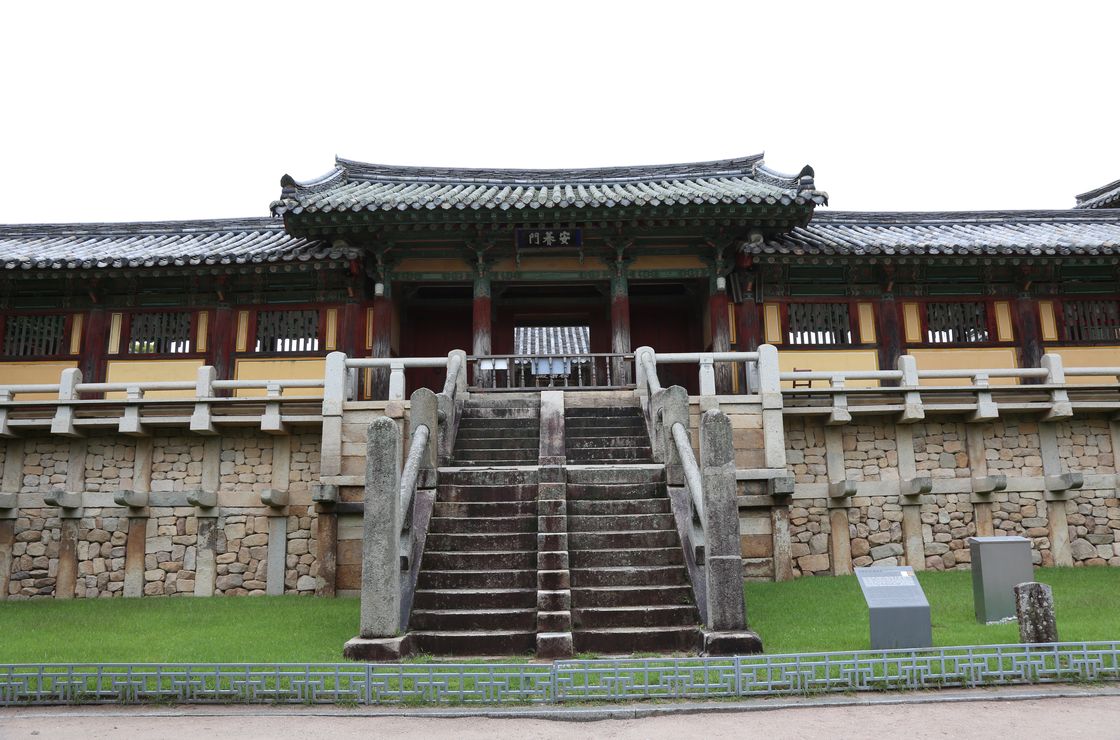
Bulguksa Temple: Masterpiece of Buddhist Architecture
Construction: 751 AD during King Gyeongdeok’s reign
Architectural Style: Classical Korean Buddhist temple
UNESCO Recognition: Outstanding example of Buddhist art and architecture
Current Status: Active temple with daily monastic life alongside tourism
Bulguksa Temple stands as supreme achievement of Korean Buddhist architecture, embodying sophisticated theological concepts in physical form while demonstrating advanced engineering and artistic skills that influenced temple construction throughout East Asia.
Buddhist Architectural Philosophy
Buddhist Cosmology in Stone: Bulguksa’s layout represents Buddhist universe in architectural form, with each element symbolizing different spiritual realms and stages of enlightenment. The famous stone bridges – Cheongungyo (Blue Cloud Bridge) and Baegungyo (White Cloud Bridge) – represent transition from earthly realm to heavenly Buddha realms.
Engineering and Construction Excellence: The stone bridges’ construction using precise fitting without mortar has withstood earthquakes for over 1,200 years. The twin pagodas – Seokgatap (simple, elegant) and Dabotap (ornate, complex) – represent different approaches to enlightenment.
Archaeological Discovery: In 1966, restoration work on Seokgatap revealed hidden chamber containing the world’s oldest known woodblock-printed text – the Pure Light Dharani Sutra – along with elaborate golden reliquary objects.
Major Changes in 2023-2025
Free Admission Policy: The most significant change occurred in May 2023 when South Korea abolished the Temple Cultural Property Collection Law, making entry to Bulguksa completely FREE for all visitors. This reflects Korea’s commitment to making cultural heritage accessible.
Practical Visiting Information (2024-2025):
- Entrance Fee: FREE since May 2023
- Parking Fee: 1,000 KRW for small cars (separate from admission)
- Operating Hours: Summer 9:00-18:00, Winter 9:00-17:00
- Best Visiting: Early morning (7:00-9:00 AM) for peaceful atmosphere
- Temple Stay Programs: Available with advance reservation
STELLA’S LOCAL SECRET
The “Free Admission Strategy”
Since Bulguksa became free in 2023, crowds increased significantly. Visit on weekday mornings (Tuesday-Thursday, 8:00-10:00 AM) when Korean tourists are fewer and tour groups haven’t arrived.
Budget reallocation: Instead of entrance fees, invest in temple stay experience (50,000-80,000 KRW) which provides overnight accommodation, traditional meals, and meditation instruction.
IMAGE TO FIND: Search for: “Seokguram Grotto Buddha statue” or “석굴암 불상” What to look for: Seokguram Grotto Buddha statue in Gyeongju, UNESCO World Heritage Site, showing the magnificent granite Buddha sculpture inside artificial stone cave temple IMAGE ALT TEXT: Seokguram Grotto Buddha statue in Gyeongju, UNESCO World Heritage Site, ancient Korean Buddhist sculpture masterpiece
Seokguram Grotto: The Pinnacle of Buddhist Sculpture Art
Construction Period: 751-774 AD under Kim Daeseong’s patronage
Architectural Type: Artificial stone cave temple
UNESCO Status: World Heritage Site jointly with Bulguksa Temple
Current Access: Limited viewing through protective glass barriers
Located 4 kilometers uphill from Bulguksa, Seokguram represents one of the most sophisticated achievements in Buddhist art and engineering. This artificial stone cave houses what many consider the finest Buddha sculpture in East Asia.
Architectural and Engineering Marvel
Scientific and Astronomical Precision: The central Buddha statue, carved from single white granite block standing 3.45 meters tall, faces east toward East Sea, precisely aligned to receive first rays of sunrise during spring and autumn equinoxes. This demonstrates sophisticated astronomical knowledge of 8th-century Korean craftsmen.
Conservation Changes: Like Bulguksa, entry became FREE in May 2023, but conservation concerns led to stricter access controls. Visitors now view sculptures exclusively through protective glass barriers, with interior photography completely prohibited.
Practical Visiting Information (2024-2025):
- Entrance Fee: FREE since May 2023
- Parking Fee: 2,000 KRW (higher than Bulguksa due to mountain location)
- Transportation: Bus #12 from Bulguksa (20 minutes) or hiking trail (45 minutes)
- Photography: Completely prohibited inside grotto
- Physical Requirements: Moderate uphill walk from parking
STELLA’S LOCAL SECRET
The “Heritage Photography Alternative”
Since interior photography is prohibited, focus on capturing Seokguram’s mountain setting and architectural exterior details. The hiking trail from Bulguksa offers numerous vantage points for mountain landscape photography.
Alternative documentation: Create detailed written observations during grotto viewing instead of relying on photography. This often produces more meaningful memories than quick smartphone photos.
Daereungwon Ancient Tomb Complex: Royal Necropolis
Historical Period: 4th-6th centuries AD
Archaeological Significance: Over 200 burial mounds
UNESCO Recognition: Outstanding example of ancient Korean burial practices
Current Status: Archaeological park with accessible tomb interior
Daereungwon preserves royal and aristocratic burials providing unprecedented insights into ancient Korean society, international trade relationships, and artistic achievements.
Revolutionary Archaeological Discoveries
Cheonmachong (Heavenly Horse Tomb): Discovered in 1973, contained over 11,500 artifacts demonstrating Silla’s extraordinary wealth. Golden crowns with jade ornaments, Persian glass vessels, Roman coins, Central Asian metalwork proved 5th-6th century Korea maintained commercial relationships spanning three continents.
International Trade Evidence: Artifacts include Persian glass vessels, Roman coins, Central Asian metalwork, Chinese ceramics proving Korean trade networks reached Mediterranean world over 1,400 years ago.
Access Changes Since 2023
New Pricing Structure:
- Park Access: FREE since 2023 for walking among exterior tomb mounds
- Cheonmachong Interior: 3,000 KRW adults (interior viewing still charged)
- Extended Hours: Now open until 22:00 for evening photography (April-October)
Practical Visiting Information (2024-2025):
- Park Entry: FREE for exterior tomb viewing
- Museum Combination: Joint tickets with Gyeongju National Museum available
- Accessibility: Wheelchair-accessible paths throughout most areas
- Photography: Permitted in outdoor areas, restricted inside tomb interior
STELLA’S LOCAL SECRET
The “Archaeological Timeline Strategy”
Visit Gyeongju National Museum first to understand Cheonmachong artifacts, then explore Daereungwon tomb mounds in afternoon when lighting enhances landscape photography. Museum knowledge transforms grass-covered hills into meaningful archaeological sites.
Cheomseongdae Observatory: Ancient Korea’s Scientific Achievement
Construction Period: 632-647 AD during Queen Seondeok’s reign
Scientific Significance: Asia’s oldest surviving astronomical structure
Current Status: Public monument with free 24-hour access
Standing elegantly near downtown Gyeongju, Cheomseongdae provides compelling evidence of advanced scientific knowledge during 7th-century Silla period.
Scientific Precision and Female Leadership
Mathematical Knowledge: Standing exactly 9.4 meters tall and constructed from 362 stone blocks (corresponding to lunar calendar days), the tower demonstrates mathematical precision rivaling contemporary Chinese and Islamic achievements.
Queen Seondeok’s Scientific Patronage: Construction during Queen Seondeok’s reign demonstrates remarkable female intellectual leadership unprecedented in 7th-century world politics. Historical records indicate she personally oversaw design while using astronomical knowledge for governance.
Access Information (2024-2025):
- Access: FREE 24-hour public access
- Illumination: Evening lighting operates sunset to midnight
- Parking: Free at nearby Daereungwon lot (5-minute walk)
- Photography: Unlimited photography permitted
- Best Times: Sunrise/sunset for dramatic lighting
STELLA’S LOCAL SECRET
The “Astronomical Appreciation Approach”
Visit Cheomseongdae at sunrise or sunset to understand how ancient astronomers used solar positioning for calendar calculations. Bring compass and note precise east-west alignment visible during equinox periods.
Practical Visiting Information: 2024-2025 Updates
Major Policy Changes
Free Admission Revolution: The biggest change affecting Gyeongju tourism occurred in May 2023 when major UNESCO sites became completely FREE:
- Bulguksa Temple: FREE (previously 5,000 KRW)
- Seokguram Grotto: FREE (previously 5,000 KRW)
- Daereungwon Park: FREE (Cheonmachong interior still 3,000 KRW)
- Cheomseongdae: FREE (always was free)
Parking Fees Remain: While admission is free, parking fees continue:
- Bulguksa: 1,000 KRW small cars
- Seokguram: 2,000 KRW small cars
- Daereungwon: Variable seasonal pricing
Transportation Updates (2024-2025)
Enhanced Public Transit:
- Bus system with English announcements and mobile app integration
- UNESCO Heritage Sites shuttle during peak seasons
- Electric bike rentals with GPS navigation expanded
From Seoul/Busan:
- KTX high-speed rail: 2.5-4 hours from Seoul
- Regular trains from Busan: 45 minutes
- Enhanced international facilities at Gyeongju Station (renovated 2023)
Budget Planning Revolution
Redirect Saved Admission Fees: With major sites now free, redirect budget (previously 15,000-20,000 KRW per person) toward:
- Temple stay programs: 50,000-80,000 KRW
- Cultural workshops: 30,000-50,000 KRW
- Private guides: 100,000-150,000 KRW per day
- Quality dining: Temple cuisine experiences
Seasonal Considerations (2024-2025)
Spring (April-May 2025):
- Advantages: Comfortable temperatures, cherry blossoms, moderate crowds
- Korean holidays: Buddha’s Birthday, Children’s Day create domestic peaks
- Photography: Optimal outdoor lighting, spring wildflowers
Autumn (September-November):
- Peak season: Spectacular foliage but highest crowds
- Advanced planning: Reservations essential for accommodations
- Perfect weather but short-lived autumn colors
Winter (December-March 2025):
- Advantages: Minimal crowds, lowest costs, peaceful experiences
- Unique opportunities: Winter temple ceremonies, traditional heating demos
STELLA’S LOCAL SECRET
The “Free Admission Budget Reallocation Strategy”
Since major sites became free in 2023, reallocate saved admission fees toward high-quality cultural experiences. One-day private guide costs less than family admission fees used to cost, but provides exponentially greater cultural understanding.
Frequently Asked Questions (Updated 2024-2025)
Q: What changed with the free admission policy in 2023? A: Bulguksa Temple, Seokguram Grotto, and most heritage sites became completely FREE due to temple cultural property law abolition. However, parking fees remain separate, and some interior experiences (Cheonmachong tomb) still charge modest fees. This increased visitor numbers significantly.
Q: How do I avoid crowds now that admission is free? A: Visit Tuesday-Thursday mornings (8:00-10:00 AM) when domestic tourists are fewer. Avoid Korean holidays and autumn foliage season. Early morning temple visits provide authentic spiritual atmosphere.
Q: Are English-language guided tours available? A: Yes, several companies offer English-speaking guides. Gyeongju Cultural Foundation provides volunteer guide matching. Private guides cost 100,000-150,000 KRW per day but provide customized education impossible through group tours.
Q: What’s the minimum time needed for meaningful visits? A: With free admission removing time pressure, plan minimum 3 full days: Day 1 – Bulguksa and Seokguram with cultural programs; Day 2 – Daereungwon, Cheomseongdae, museums; Day 3 – supplementary sites and workshops.
Q: Can I participate in Buddhist temple activities? A: Yes, Bulguksa offers temple stay programs (overnight), meditation sessions (2-3 hours), and cultural experiences. Since admission became free, these paid programs became primary revenue source, so advance reservations essential.
Q: How has the policy change affected conservation? A: Heritage sites shifted to cultural programs and guided tours for revenue. Government funding increased to compensate for lost admission revenue. Photography restrictions increased significantly for conservation.
Q: What accommodation options exist near UNESCO sites? A: Traditional hanok guesthouses increased since 2023. International hotels expanded Gyeongju presence. Temple stay programs provide overnight accommodation with cultural immersion. Book well in advance during autumn season.
Q: Best way to combine Gyeongju with other Korean destinations? A: Excellent connections with Busan (45 minutes) for coastal attractions, Seoul via KTX for metropolitan experiences, Andong (2 hours) for additional UNESCO sites. Free admission allows more flexible scheduling.
Walking Through Korea’s Millennium of Achievement
You now possess comprehensive, up-to-date knowledge to visit Gyeongju Historic Areas UNESCO World Heritage Site with deep understanding of Silla Dynasty achievements and practical awareness of recent policy changes affecting heritage tourism in Korea. You understand how Buddhist temple architecture embodies sophisticated theological concepts and why free admission since 2023 changed visiting dynamics while maintaining spiritual significance.
The elimination of major admission fees represents philosophical shift recognizing cultural heritage as public good while creating opportunities for deeper, more meaningful cultural experiences through premium programs and educational services. Your visiting during this transitional period contributes to ongoing experiments in heritage tourism management.
Through careful exploration of Gyeongju Historic Areas, international visitors gain not only historical knowledge but also insights into contemporary Korean values regarding cultural preservation, public access to heritage, and integration of ancient achievements with modern social needs.
The five UNESCO designated areas await throughout Gyeongju, now more accessible than ever before. Ancient temples preserve Buddhist wisdom in architectural perfection available without financial barriers. Royal tombs contain golden treasures proving ancient international connections. Astronomical observatories demonstrate scientific achievement and female leadership, freely accessible for 24-hour appreciation.
Your journey through Korea’s thousand-year golden age begins now, with unprecedented access and opportunity for cultural discovery.