Discovering Korea’s Lost Ancient Kingdom
Have you ever wanted to understand the sophisticated ancient Korean kingdom that flourished for 700 years, developed refined Buddhist culture that influenced Japanese civilization, built elegant palaces and temples rivaling China’s architecture, and then vanished so completely after military defeat that most of its history remained buried underground for 1,300 years until modern archaeological excavations revealed its splendor? Where you can walk through three different capital cities representing three distinct periods of the same kingdom’s evolution, seeing how political circumstances, foreign invasions, and cultural development shaped urban planning and architectural styles? Where UNESCO recognizes not individual monuments but an entire cultural landscape preserving evidence of ancient East Asian civilization at its height – royal fortresses, Buddhist temples, elaborate tombs, city planning systems, and international cultural exchange? The Baekje Historic Areas (백제역사유적지구/百濟歷史遺跡地區) offer exactly this experience – but only if you understand what Baekje was, why it matters beyond Korean nationalism, how these eight archaeological sites together tell coherent story about ancient kingdom’s rise and fall, and what makes Baekje culture distinctive even among Korea’s Three Kingdoms period civilizations.
For Western visitors especially, Baekje Historic Areas present fascinating challenges because unlike well-preserved Greek or Roman ruins, Korean archaeological sites often consist primarily of foundations, excavated remains, and reconstructions rather than standing ancient buildings. Understanding requires imagination informed by historical knowledge, archaeological interpretation, and cultural context that transforms earthen mounds, foundation stones, and museum artifacts into evidence of sophisticated ancient civilization. The sites aren’t immediately spectacular like Angkor Wat or the Colosseum – they reveal their significance gradually to visitors who invest effort understanding what they’re seeing and why it matters.
Most visitors approach Baekje sites as generic “old Korean stuff” without distinguishing Baekje from other Korean historical periods, understanding Three Kingdoms era geopolitics that shaped peninsula’s cultural development, or appreciating how Baekje’s particular character – cosmopolitan, artistic, Buddhist, internationally engaged – differed from militaristic Goguryeo in the north or strategically positioned Silla in the southeast. They photograph tomb mounds and temple foundations without knowing why UNESCO designated these particular eight sites as representing “exceptional testimony to the development of Baekje Kingdom culture, its architecture, its religious worship and its funerary traditions.”
I understand that superficial engagement completely. My first Baekje site visit (Buyeo’s Jeongnimsa Temple Site) left me puzzled about what exactly I was looking at – a five-story stone pagoda standing in empty field with foundation stones marked by low walls seemed historically important but visually underwhelming compared to complete standing temples I’d visited elsewhere in Korea. Without context about Baekje Buddhism, temple architecture evolution, or why this particular pagoda’s elegant proportions influenced later Korean Buddhist art, the site registered as “old stones” rather than testament to ancient civilization’s aesthetic refinement.
That’s why this comprehensive guide exists. I’m going to share everything you need to transform Baekje Historic Areas visiting from confused archaeological tourism into meaningful encounter with ancient Korean civilization that shaped East Asian cultural development. You’ll learn exactly what Baekje was within Three Kingdoms period context, why the kingdom moved capitals three times creating three distinct archaeological zones, what each of the eight UNESCO sites reveals about different aspects of Baekje culture, and how to visit them efficiently despite geographic spread across three modern cities. You’ll understand Baekje’s international importance through cultural exchange with China and Japan, why the kingdom’s 660 CE defeat by Silla-Tang alliance ended one of Korean history’s most culturally sophisticated periods, and what modern archaeology continues revealing about this nearly-forgotten civilization.
By the end of this guide, you’ll know how to visit Baekje Historic Areas with understanding that transforms simple foundation stones into evidence of palace layouts, earthen mounds into elaborate royal tombs, museum artifacts into windows on ancient daily life, and reconstructed buildings into informed hypotheses about original structures’ appearance. You’ll appreciate why these eight scattered sites needed UNESCO designation as integrated serial property rather than individual monuments. You’ll understand what makes Baekje culture unique even among ancient Korean civilizations. Most importantly, you’ll grasp why studying nearly-vanished ancient kingdom matters for understanding Korean cultural identity, East Asian historical relationships, and universal human questions about how civilizations rise, flourish, decline, and sometimes disappear leaving only fragmentary archaeological evidence.
Understanding Baekje: The Kingdom and Its Context
The Three Kingdoms Period: Historical Framework
To understand Baekje, Western visitors must first grasp the Three Kingdoms period (삼국시대/三國時代, approximately 57 BCE – 668 CE) that shaped Korean peninsula’s cultural and political development for seven centuries:
Three Major Kingdoms:
Goguryeo (고구려/高句麗, 37 BCE – 668 CE): Occupied northern Korean peninsula and southern Manchuria, characterized by military strength, territorial expansion, frequent conflicts with Chinese dynasties, and fierce independence maintaining Korean autonomy against Chinese imperial pressure. Goguryeo developed distinctive martial culture, built massive mountain fortresses, and created spectacular tomb murals showing daily life, religious beliefs, and cultural achievements.
Baekje (백제/百濟, 18 BCE – 660 CE): Occupied southwestern Korean peninsula, characterized by cultural refinement, international trade, diplomatic sophistication, advanced Buddhism, artistic achievement, and particularly close relationships with southern Chinese dynasties and Japanese Yamato state. Baekje served as primary conduit transmitting Chinese civilization including Buddhism, Confucianism, writing systems, and various technologies to Japanese islands.
Silla (신라/新羅, 57 BCE – 935 CE): Initially smallest and weakest kingdom occupying southeastern corner of peninsula, characterized by strategic positioning allowing survival while Goguryeo and Baekje fought each other, eventual alliance with Tang China enabling conquest of both rival kingdoms, and ultimate unification of peninsula under Silla control creating first unified Korean state (Unified Silla period, 668-935 CE).
Three Kingdoms Dynamics:
The period involved continuous warfare, shifting alliances, territorial exchanges, and intense competition for Chinese recognition and support. Cultural development occurred alongside military conflict, with each kingdom developing distinctive characteristics while sharing fundamental Korean identity and competing for peninsula dominance. Understanding this context explains why Baekje moved capitals (military threats), why it developed sophisticated diplomacy (survival strategy for kingdom caught between larger northern Goguryeo and rising eastern Silla), and why its 660 CE defeat by Silla-Tang alliance ended not just political entity but entire cultural tradition.
What Was Baekje? Core Characteristics
Baekje Kingdom exhibited several distinctive characteristics that scholars recognize as defining its civilization:
Cultural Refinement and Aesthetics: Among the Three Kingdoms, Baekje particularly emphasized artistic excellence, elegant proportions, and aesthetic sophistication. Baekje Buddhist art shows graceful forms contrasting with Goguryeo’s more robust martial style or Silla’s later ornate elaboration. This aesthetic character appears in everything from temple architecture to tomb construction to pottery and metalwork.
International Orientation: Unlike isolated Goguryeo fighting Chinese dynasties or peripheral Silla developing in relative isolation, Baekje actively engaged international trade and diplomacy. The kingdom maintained embassies in southern Chinese dynasties (particularly Southern Liang and Southern Qi during North-South Division period), sent missions to Japanese Yamato court, and welcomed foreign monks, scholars, and craftsmen creating cosmopolitan culture unusual in ancient Korea.
Buddhist Excellence: While all Three Kingdoms adopted Buddhism, Baekje particularly excelled in Buddhist culture. Baekje monks studied in China and India, Baekje craftsmen created refined Buddhist art and architecture, and Baekje played crucial role transmitting Buddhism to Japan (sending monks, texts, and Buddha images to Yamato court in 6th century CE, traditionally dated to 538 CE). This Buddhist emphasis shaped Baekje’s material culture profoundly.
Strategic Location: Baekje controlled Han River basin and western/southwestern coasts, providing access to China via Yellow Sea and to Japan via Korea Strait. This geographic position enabled maritime trade and cultural exchange that enriched Baekje culture while creating strategic vulnerability when enemies controlled sea routes.
Centralized Administration: Archaeological evidence and historical records indicate Baekje developed sophisticated government administration with central bureaucracy, provincial governance, tax systems, and organized military earlier than neighboring kingdoms, contributing to the kingdom’s cultural achievements despite smaller territory than Goguryeo.
Why Three Capitals? Baekje’s Political Evolution
Understanding why Baekje Historic Areas encompass three different cities requires knowing Baekje’s political history and capital relocations:
Wiryeseong Period (18 BCE – 475 CE): Seoul Area Capital
Baekje’s first capital occupied Han River basin in modern Seoul area (exact location debated by scholars). During this period Baekje expanded territorially, developed state administration, adopted Buddhism officially (384 CE), and competed with Goguryeo for peninsula dominance. However, 475 CE saw catastrophic defeat when Goguryeo’s King Jangsu invaded, captured Wiryeseong, killed Baekje’s King Gaero, and forced Baekje to abandon its ancestral capital fleeing southward.
Ungjin Period (475 – 538 CE): Gongju Capital
After 475 CE disaster, Baekje relocated capital to Ungjin (modern Gongju), establishing new center approximately 150 km south of lost Seoul territory. This 63-year period involved recovery from near-destruction, reorganization of government and military, alliance-building with southern Chinese dynasties, and cultural development despite reduced territory and resources. The Ungjin period represents Baekje resilience and adaptation following existential military defeat.
Sabi Period (538 – 660 CE): Buyeo Capital
In 538 CE, King Seong relocated capital again to Sabi (modern Buyeo), just 20 km from Gongju. Reasons for this second move remain debated – better geomantic location, desire for fresh start disassociated from defeat memories, superior access to Geum River for trade and transportation, or combination of factors. The Sabi period represents Baekje’s cultural golden age with flourishing Buddhism, international exchange, artistic achievement, and stable governance – until Silla-Tang alliance destroyed the kingdom in 660 CE.
Iksan’s Ambiguous Status
Iksan presents scholarly puzzle. Historical sources suggest King Mu (r. 600-641) may have planned or partially implemented another capital move to Iksan, located between Gongju and Buyeo. Massive palace foundations and ambitious temple ruins (Mireuksa, largest Korean temple of its era) support theory of intended capital, but whether Iksan served as actual capital, secondary royal residence, or merely site of royal patronage remains unresolved. UNESCO inclusion recognizes Iksan’s importance while acknowledging historical ambiguity.
Baekje vs. Goguryeo vs. Silla: Cultural Distinctions
Understanding what made Baekje distinctive requires comparing it with contemporary kingdoms:
Military Character: Goguryeo excelled in military affairs, building massive fortresses, maintaining strong cavalry forces, and frequently fighting Chinese dynasties. Silla developed military strength later, ultimately conquering peninsula through Tang alliance. Baekje, while maintaining capable military, emphasized diplomacy and culture over martial prowess, making it vulnerable to sustained military pressure from larger neighbors.
Cultural Characteristics: Baekje favored elegance and refinement, Goguryeo preferred bold martial aesthetics, Silla initially showed simpler styles evolving toward elaborate ornamentation after unification. These aesthetic differences appear consistently in art, architecture, and material culture from each kingdom.
International Relations: Baekje actively engaged China and Japan through trade and diplomacy, Goguryeo fought China while ignoring Japan, Silla initially remained isolated before allying with Tang China for strategic advantage. These different international orientations shaped each kingdom’s cultural development and political fate.
Buddhist Development: All three kingdoms adopted Buddhism, but with different emphases. Baekje Buddhism showed sophisticated philosophical understanding and artistic refinement, serving as conduit to Japan. Goguryeo Buddhism integrated with shamanic traditions and state ideology. Silla Buddhism developed slowly until after unification, then flourished magnificently in Unified Silla period.
Archaeological Evidence: Goguryeo left spectacular tomb murals showing daily life and beliefs. Silla left elaborate gold crowns and jewelry from royal tombs. Baekje left elegant stone pagodas, refined Buddhist sculpture, sophisticated tile work, and urban planning systems – different material legacies reflecting different cultural priorities.
Why Baekje Matters: Historical Significance
Understanding why nearly-vanished kingdom deserves serious study requires recognizing Baekje’s historical importance:
Cultural Transmission to Japan: Baekje served as primary channel transmitting Chinese and Korean civilization to Japanese islands during crucial Asuka period (538-710 CE) when Japan was developing from tribal society toward centralized state. Baekje sent Buddhism, Confucian texts, writing systems, governmental models, architectural techniques, and various technologies to Japan. This cultural transmission shaped Japanese civilization fundamentally – without Baekje intermediary, Japanese cultural development would have followed completely different trajectory.
Korean Cultural Identity: Baekje represents one of three foundational Korean civilizations whose synthesis created later unified Korean culture. Modern Korean aesthetic preferences, cultural values, and historical consciousness incorporate Baekje elements alongside Goguryeo and Silla contributions. Understanding Baekje helps understanding Korean cultural identity beyond modern nationalism.
Archaeological Knowledge: Baekje sites preserve crucial evidence about ancient East Asian urban planning, architecture, Buddhism, art, and international exchange that written sources don’t fully capture. Archaeological excavations continue revealing new information about ancient civilization and cultural development.
UNESCO Universal Value: UNESCO recognition affirms Baekje’s importance beyond Korean national history as evidence of universal human cultural achievement – ancient society’s sophisticated urban planning, religious development, artistic excellence, and international engagement that speak to fundamental questions about civilization.
Personal Story: Understanding Through Comparison
My own Baekje understanding transformed during trip visiting all three capital cities within single week, allowing direct comparison impossible through scattered individual visits. Gongju felt defensive and compact – mountainside fortress protecting small city recovering from catastrophe. Buyeo felt confident and expansive – riverside plains supporting larger urban center during prosperous period. Iksan felt ambitious and uncertain – massive temple foundations suggesting grand plans that historical destruction prevented from completion.
This comparative visiting revealed what individual site visits couldn’t – how political circumstances shaped urban planning, how confidence or insecurity appeared in architectural choices, how cultural development followed or preceded political security. The three cities together told coherent story about kingdom’s evolution from survival to flourishing to final overreach, making abstract historical narrative concrete through physical landscape.
Pros of Understanding Baekje Context
- Historical Depth: Understanding Three Kingdoms period and Baekje’s role adds intellectual dimension to site visiting, transforming simple tourism into encounter with complex ancient history and cultural development.
- Archaeological Appreciation: Historical knowledge helps interpreting fragmentary archaeological remains, allowing informed imagination about original structures and purposes rather than confusion about “old stones.”
- International Perspective: Learning about Baekje-China-Japan cultural exchange provides cross-cultural understanding about East Asian civilization development beyond nationalist narratives any single country promotes.
- Cultural Literacy: Baekje knowledge enriches understanding of Korean culture, Japanese history, and East Asian Buddhism through grasping foundational historical relationships.
- Comparative Framework: Understanding how Baekje differed from Goguryeo and Silla allows recognizing diversity within ancient Korean civilization rather than assuming monolithic “Korean culture” existed historically.
Cons of Baekje Study
- Complexity: Full appreciation requires substantial knowledge about Korean history, Chinese dynasties, Japanese ancient period, Buddhism, archaeology, and ancient East Asian geopolitics – challenging background for casual tourists.
- Limited Sources: Unlike well-documented civilizations with extensive written records, Baekje sources are fragmentary (most Baekje documents were destroyed after 660 CE defeat), requiring scholars to reconstruct history from archaeological evidence, Chinese records, and Japanese sources – creating uncertainties and scholarly debates.
- Archaeological Nature: Unlike standing ancient architecture at sites like Athens or Rome, Baekje remains are mostly excavated foundations and reconstructions, requiring more imaginative effort and historical knowledge for appreciation.
- Geographic Spread: Understanding complete Baekje story requires visiting three different modern cities spread across central-western Korea, demanding more time and travel than single-site visiting.
- Translation Challenges: Much Baekje scholarship exists only in Korean, Chinese, or Japanese, limiting English-speaking visitors’ access to detailed research and interpretations.
STELLA’S LOCAL SECRET
The “Three Capitals in Three Days” Itinerary
For visitors wanting comprehensive Baekje understanding, dedicate three consecutive days visiting Gongju (Day 1), Buyeo (Day 2), and Iksan (Day 3) in historical chronological order. This concentrated touring allows comparing the three capitals directly while Baekje context remains fresh, revealing patterns and evolution impossible to recognize through scattered visiting.
Why chronological order matters: Starting at Gongju (defensive recovery capital) establishes baseline, Buyeo (prosperous golden age capital) shows cultural flowering, Iksan (ambitious final expansion) reveals ultimate limitations. This progression makes historical narrative concrete through physical experience of changing urban character.
Practical logistics: All three cities are accessible from Seoul via train or express bus (1.5-2.5 hours), though reaching Iksan from Buyeo requires backtracking through junction cities. Consider renting car for maximum flexibility, or use combination of trains and local buses with careful schedule research.
Educational value: Three-day immersion with each evening reviewing what you’ve seen and reading about next day’s sites creates intensive learning experience that scattered visits across months cannot match. You’ll finish with coherent Baekje understanding rather than confused memories of disconnected archaeological sites.

The Eight UNESCO Sites: Detailed Exploration
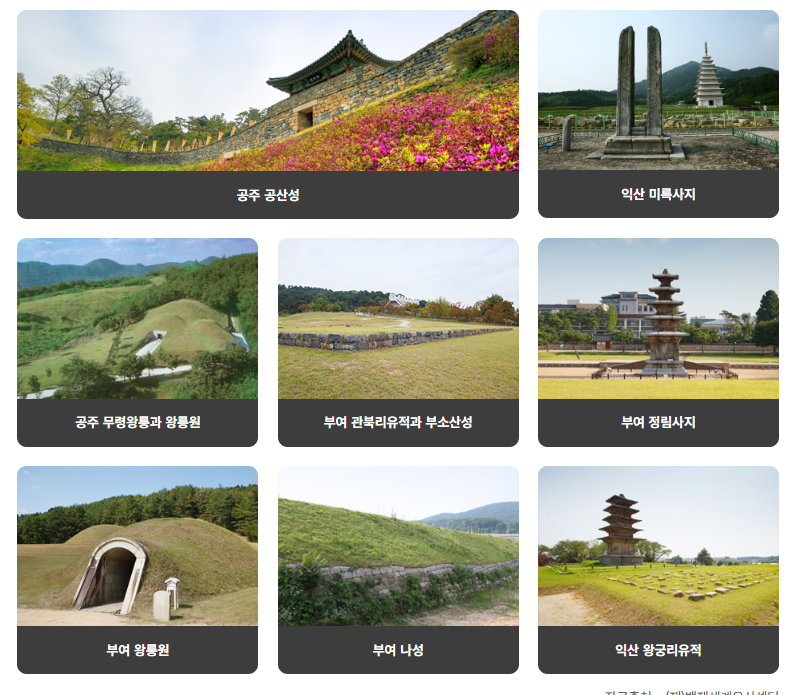
Site 1: Gongsanseong Fortress (공산성) – Gongju
Period: Ungjin (475-538 CE)
Function: Royal fortress and administrative center
Current Status: Well-preserved fortress walls with reconstructed gates and buildings
Gongsanseong served as Baekje’s main fortress protecting Ungjin capital during 63-year recovery period after catastrophic 475 CE defeat. The fortress occupies strategic hilltop position overlooking Geum River, providing defensive advantages while controlling river transportation crucial for trade and communication.
Architectural Significance:
The fortress demonstrates sophisticated military engineering with approximately 2.5 km earthen and stone walls following natural ridge lines, creating defensible perimeter enclosing roughly 22 hectares. Original construction used pounded earth (판축/版築, rammed earth technique Chinese-influenced), later strengthened with stone facing during Joseon Dynasty (1392-1910) reuse. This dual construction method preserves evidence of both Baekje and later historical periods in same structure.
Four gates punctuate the walls at cardinal directions, with current structures representing modern reconstructions based on archaeological evidence and historical records. Gate architecture shows typical Korean fortress style with two-story pavilion structures above stone foundations, though original Baekje gates likely differed from current Joseon-style reconstructions.
Inside the fortress, archaeological excavations revealed foundation remains of various buildings including administrative structures, military facilities, warehouses, and possibly royal residence, though most above-ground buildings have disappeared. Several buildings have been reconstructed to suggest original fortress townscape, though visitors should understand these represent informed hypotheses rather than precise replications.
Historical Context:
Gongsanseong’s defensive emphasis reflects Baekje’s vulnerable position after losing northern territories to Goguryeo. The fortress needed to protect king and government against potential further attacks while providing secure base for kingdom reorganization. This security-focused capital contrasts dramatically with later Buyeo’s more open, confident urban planning during prosperous Sabi period.
Historical records indicate several Baekje kings resided here, ruling from this fortified position during Ungjin period. The fortress witnessed kingdom’s slow recovery, diplomatic initiatives with southern Chinese states, internal political conflicts, and eventually preparation for new beginning with Sabi capital establishment.
Visiting Experience:
Walking Gongsanseong’s walls provides both historical understanding and beautiful views over Geum River and modern Gongju city. The approximately 1-hour circuit following wall perimeter allows grasping defensive layout while imagining ancient fortress town’s appearance.
Inside the fortress, the Temporary Palace (임류각/Imryugak) represents reconstructed royal residential facility suggesting how Baekje kings might have lived. While architectural details are speculative, the building provides tangible sense of place and scale missing from bare foundation stones.
Visiting Highlights:
- Complete fortress wall circuit with panoramic river and city views
- Four reconstructed gates showing traditional Korean fortress architecture
- Foundation remains revealing ancient building layouts
- Museum displays explaining excavation findings and Baekje history
- Beautiful seasonal changes (spring cherry blossoms, autumn colors)
Visiting Challenges:
- Modest scale means 1-2 hour visiting time sufficient for most tourists
- Reconstruction versus original structures requires distinguishing through interpretation
- Steep hills and stairs challenging for visitors with mobility limitations
- Limited English interpretation compared to more touristy Seoul palace sites
Site 2: Songsan-ri Tombs (송산리 고분군) – Gongju
Period: Ungjin (475-538 CE)
Function: Royal burial ground
Current Status: Tomb mounds with one tomb (Muryeong’s) containing original contents; exhibition hall displays replica tomb interior
Songsan-ri contains seven Baekje royal tombs including tomb of King Muryeong (武寧王, r. 501-523 CE), one of Baekje’s most important rulers during Ungjin period. The tomb group represents Baekje funerary architecture and burial practices during kingdom’s recovery phase.
Archaeological Significance:
King Muryeong’s tomb holds extraordinary importance as only scientifically excavated undisturbed Baekje royal tomb, discovered accidentally during drainage work in 1971. The tomb contained over 4,600 artifacts including gold crowns, jewelry, Chinese coins, wooden coffins, and tomb tablets identifying occupants with exact dates – unprecedented archaeological windfall providing concrete evidence about Baekje royal culture and international connections.
The tomb’s brick construction shows Chinese influence (brick chamber tombs were popular in southern Chinese dynasties during this period), suggesting Baekje actively adopted contemporary Chinese architectural techniques while adapting them to Korean context. The tomb’s intact condition allowed archaeologists to study original burial procedures, artifact arrangements, and construction methods impossible to research in previously looted tombs.
Funerary Architecture:
Baekje royal tombs at Songsan-ri show evolution from earlier Korean stone chamber tombs toward Chinese-influenced brick construction, demonstrating kingdom’s cultural cosmopolitanism and willingness to adopt foreign innovations. The transition from stone to brick reflects broader Baekje pattern of looking toward Chinese civilization for models while maintaining Korean identity.
Tomb mounds’ external appearance – grassy artificial hills – follows East Asian tumulus tradition appearing across Korea, China, and Japan, though internal structures vary by region and period. Baekje tumuli are generally more modest in scale than massive Goguryeo tombs in north or elaborate Silla tombs in southeast, reflecting Baekje’s different political circumstances and aesthetic preferences.
Visiting Experience:
The tomb site allows walking among earthen mounds understanding landscape as royal cemetery, though tomb interiors are closed protecting fragile remains. Instead, visitors enter excellent exhibition hall housing full-scale replica of King Muryeong’s tomb showing exactly how original appeared when discovered – complete with replica artifacts positioned as found during excavation.
This replica approach solves modern heritage conservation challenge: how to share extraordinary archaeological discovery with public while protecting irreplaceable original from damage caused by environmental exposure and visitor traffic. The replica provides access to tomb’s appearance and meaning while preserving actual tomb sealed and protected.
Museum Collection:
Original artifacts from King Muryeong’s tomb now reside in Gongju National Museum (short distance from tomb site), creating essential companion visit. The museum displays gold crowns decorated with flame-like ornaments, delicate gold jewelry, bronze mirrors from southern China, wooden coffin fragments, and crucially the stone tablets identifying tomb occupants and providing exact death dates – extraordinary historical documents discovered intact after 1,450 years.
Visiting Highlights:
- Replica tomb interior showing exact archaeological discovery conditions
- Tomb mound landscape conveying royal cemetery atmosphere
- Gongju National Museum displaying spectacular original artifacts
- Educational displays explaining Baekje burial practices and international connections
- Walking distance from Gongsanseong for efficient combined visiting
Visiting Challenges:
- Cannot enter original tombs (sealed for preservation)
- Replica nature requires explaining to visitors expecting “real” tomb access
- Modest external appearance (grassy mounds) may disappoint visitors expecting visual drama
- Museum displays sometimes lack English labels with detailed contextual information
Site 3 & 4: Gwanbuk-ri Site (관북리 유적) and Busosanseong Fortress (부소산성) – Buyeo
Period: Sabi (538-660 CE)
Function: Administrative district and royal fortress
Current Status: Excavated foundations with some reconstructions
These two adjacent sites in Buyeo represent Baekje’s final capital during its cultural golden age, showing confident urban planning contrasting with defensive Gongju fortress.
Gwanbuk-ri Administrative Complex:
Archaeological excavations revealed extensive foundation remains of government administrative buildings, suggesting sophisticated bureaucratic system managing kingdom affairs. The building layouts show systematic planning with clear functional divisions, courtyards, and organized spatial relationships indicating mature governmental administration.
Unlike earlier capitals’ defensive emphasis, Gwanbuk-ri shows open layout suggesting confidence in kingdom’s security during Sabi period prosperity. Building remains indicate combination of administrative offices, storage facilities, and possibly residential quarters for officials, creating government district serving centralized state apparatus.
Foundation remains show building construction techniques including stone base platforms, drainage systems, and sophisticated architectural planning, though above-ground wooden buildings have completely disappeared leaving only stone evidence.
Busosanseong Fortress:
Adjacent to Gwanbuk-ri, Busosanseong fortress occupies low mountain (Busosan, elevation 106m) overlooking both the administrative district and Baekganggang River (modern Geum River). The fortress provided last defensive position when Silla-Tang allied forces attacked in 660 CE, witnessing kingdom’s final destruction.
The fortress walls follow mountain ridge creating roughly 2.5 km perimeter similar to Gongsanseong but with more relaxed defensive character reflecting Sabi period’s initially peaceful conditions. Inside the fortress, scattered pavilions and temples create park-like atmosphere contrasting with Gongsanseong’s military emphasis.
Tragic Historical Association:
Busosanseong achieved tragic fame as site of Baekje’s final defense in 660 CE. According to historical accounts and later legendary elaborations, when Silla-Tang forces breached defenses and captured the capital, court ladies threw themselves from cliff called Nakwhaam (낙화암/落花岩, “Falling Flowers Rock”) into river below rather than face capture – romantic tragic narrative becoming central element in Korean cultural memory about Baekje’s fall.
While historians debate whether mass suicide actually occurred or represents later literary embellishment, Nakwhaam cliff remains powerful memorial site where modern visitors contemplate kingdom’s destruction and cultural loss, connecting contemporary consciousness with ancient tragedy across 1,300+ years.
Visiting Highlights:
- Gwanbuk-ri foundation remains showing sophisticated urban planning
- Busosanseong forest trails with historical pavilions and temples
- Nakwhaam cliff and associated tragic historical narrative
- Panoramic views over Buyeo city and Geum River from fortress heights
- Combined sites allow understanding administrative district and defensive fortress relationship
Visiting Challenges:
- Foundation remains require substantial imagination and historical knowledge for appreciation
- Limited reconstruction means mostly viewing stone platforms rather than standing buildings
- Busosanseong’s park-like modern character may obscure military historical function
- Connecting scattered remains into coherent mental picture of ancient capital requires effort
Site 5: Jeongnimsa Temple Site (정림사지) – Buyeo
Period: Sabi (538-660 CE)
Function: Royal Buddhist temple
Current Status: Five-story stone pagoda (original) with excavated foundation remains; museum
Jeongnimsa represents Baekje Buddhist architecture at its finest, with the surviving five-story stone pagoda considered masterpiece of ancient Korean art and crucial evidence for understanding Baekje aesthetic principles.
The Five-Story Pagoda:
The pagoda, standing 8.33 meters tall, exemplifies Baekje’s elegant proportions and refined carving techniques. Unlike earlier wooden pagodas (which have disappeared) or later elaborate stone pagodas with complex decorative elements, Jeongnimsa’s pagoda shows restrained beauty emphasizing balanced proportions, subtle details, and structural clarity.
The pagoda’s influence on later Korean Buddhist architecture cannot be overstated – it established aesthetic principles that later Korean stone pagodas followed for centuries. Japanese architectural historians also recognize Jeongnimsa pagoda’s influence on early Japanese Buddhist pagoda design, particularly regarding proportional relationships and decorative restraint.
Each story features carved details representing wooden architectural elements – simulated roof tiles, corner posts, and structural beams – showing how Baekje craftsmen translated wooden building traditions into permanent stone form. This translation process reveals sophisticated understanding of both materials and architectural principles.
Temple Layout:
Archaeological excavations around the pagoda revealed extensive temple foundation remains showing original complex’s scale and organization. The temple followed typical Mahayana Buddhist layout with central pagoda, main worship hall, lecture hall, and monks’ residential quarters arranged along north-south axis within rectangular compound.
Foundation stones indicate buildings were substantial wooden structures raised on stone platforms, following Chinese Buddhist architectural models while incorporating Korean modifications. The systematic layout demonstrates mature understanding of Buddhist architectural principles and urban planning sophistication.
Historical Significance:
Jeongnimsa likely served as major royal temple receiving substantial court patronage during Sabi period. The temple’s central location in capital city, elaborate architecture, and continuing historical importance (later periods added inscriptions and modifications) suggest it functioned as important religious and political symbol of Baekje royal Buddhism.
After Baekje’s fall, Silla renamed the temple and added inscription to the pagoda commemorating Tang Chinese general’s victory – ironic transformation of Baekje monument into Silla-Tang triumph memorial. This historical layering makes the pagoda simultaneously Baekje cultural achievement and evidence of the kingdom’s tragic defeat.
Museum Experience:
The on-site museum displays artifacts excavated from temple grounds including roof tiles decorated with lotus patterns, Buddha statues, ritual objects, and architectural fragments. These objects provide tangible evidence of Baekje Buddhist material culture and artistic capabilities beyond what foundation stones alone can reveal.
Visiting Highlights:
- Five-story stone pagoda as masterpiece of Baekje Buddhist art
- Foundation remains showing complete temple layout
- Museum artifacts providing material evidence of Baekje Buddhism
- Peaceful temple grounds suitable for contemplative visiting
- Central Buyeo location allowing easy access
Visiting Challenges:
- Site consists primarily of single pagoda in empty field, which may seem minimal to visitors expecting complete temple complex
- Understanding pagoda’s artistic significance requires some background in Buddhist architecture and Korean art history
- Foundation stones require imagination to mentally reconstruct original wooden buildings
- Brief visiting time (30-60 minutes) unless combining with extensive museum study
Site 6: Neungsan-ri Tombs (능산리 고분군) – Buyeo
Period: Sabi (538-660 CE)
Function: Royal burial ground
Current Status: Seven tomb mounds; associated temple site with stone structures
Neungsan-ri tomb complex contains seven large burial mounds believed to hold Baekje kings and royal family members from Sabi period. The tomb group represents continuation of Baekje royal funerary traditions at the new capital.
Royal Cemetery:
The seven tombs occupy gentle hillside south of Buyeo city center, creating royal cemetery landscape similar to earlier Gongju Songsan-ri tombs but larger in scale reflecting Sabi period’s greater prosperity and confidence. Individual tomb mounds range from 10-20 meters in diameter, with the largest likely containing most important royalty.
Unlike King Muryeong’s tomb in Gongju, these tombs were looted in antiquity, removing most original burial goods before modern archaeological investigation. However, stone chamber construction, tomb layouts, and remaining artifacts still provide valuable information about Baekje funerary architecture and royal burial practices during the kingdom’s final period.
Stone chamber construction shows technical sophistication with carefully fitted granite blocks creating burial chambers, entrance passages, and protective structures. The chambers’ internal arrangements indicate bodies were placed in wooden coffins surrounded by burial goods, following traditions established during earlier periods but adapted to Sabi context.
Associated Temple Site:
Adjacent to the tombs, excavations revealed remains of Buddhist temple (Neungsan-ri Temple) built to conduct memorial services for deceased royalty – unique combination of tomb complex and associated memorial temple showing how Baekje integrated Buddhist practices with traditional ancestral veneration.
The temple site yielded important artifacts including a gilt-bronze incense burner (백제금동대향로/Baekje Gilt-bronze Incense Burner) now considered Korean national treasure and one of finest examples of Baekje metalwork. The incense burner’s elaborate decoration depicting mountains, heavenly beings, musicians, and animals demonstrates Baekje craftsmen’s extraordinary technical skill and sophisticated Buddhist-Daoist cosmological understanding.
Archaeological Significance:
Though looted, Neungsan-ri tombs still revealed important information about Baekje stone working techniques, tomb construction methods, and the relationship between political power (royal burials) and religious practice (memorial temple). The combination of cemetery and temple represents distinctive Baekje approach to royal commemoration blending indigenous Korean ancestral practices with imported Buddhist traditions.
Visiting Highlights:
- Seven impressive tomb mounds in scenic hillside setting
- Associated temple foundations showing unique tomb-temple relationship
- Museum displaying spectacular gilt-bronze incense burner and other artifacts
- Peaceful atmosphere suitable for contemplative visiting
- Views over surrounding countryside from tomb hillside
Visiting Challenges:
- Cannot enter tomb chambers (sealed for preservation)
- Looted condition means fewer spectacular artifacts than King Muryeong’s intact tomb
- Understanding significance requires knowing about Baekje funerary practices and Buddhist memorial traditions
- Modest scale means relatively brief visiting time
Site 7: Naseong City Wall (나성) – Buyeo
Period: Sabi (538-660 CE)
Function: Outer city defensive wall
Current Status: Partial remains of earthen wall extending several kilometers
Naseong represents Sabi capital’s outer defensive perimeter, demonstrating sophisticated urban planning that protected city while accommodating substantial urban population and economic activities.
Urban Planning Significance:
Unlike earlier Korean cities that often relied on natural mountain positions for defense (as Gongsanseong did), Buyeo’s Naseong shows systematic urban planning with constructed defensive perimeter creating roughly rectangular protected zone. This planned approach reflects confidence, administrative capacity, and sophisticated understanding of urban defensive systems.
The wall originally extended approximately 6-7 kilometers, enclosing area of several square kilometers that encompassed palace district (Gwanbuk-ri), fortress (Busosanseong), temples, residential areas, markets, and workshops. This integrated urban system represents most ambitious Baekje urban planning project, creating capital city scaled to kingdom’s needs during its most prosperous period.
Construction Techniques:
Archaeological investigation revealed Naseong was built using pounded earth techniques with layers of soil compacted to create solid defensive barrier. The wall originally stood several meters high with defensive ditches along outer perimeter, creating formidable obstacle to attacking forces.
Different sections show construction variations suggesting the wall was built in phases over extended period as city expanded and defensive needs evolved. Some sections incorporated natural terrain features while others crossed level ground requiring entirely constructed barriers.
Current Condition:
Unlike well-preserved fortress walls at Gongsanseong and Busosanseong, Naseong has largely disappeared through centuries of erosion, agricultural activity, and urban development. Only fragmentary sections remain visible, requiring archaeological expertise and historical knowledge to recognize and interpret.
Conservation efforts have preserved and marked some sections, allowing visitors to see original wall construction and understand overall defensive system’s scale. However, grasping Naseong’s significance requires substantial imagination and reference to archaeological surveys showing complete perimeter.
Visiting Highlights:
- Preserved wall sections showing ancient construction techniques
- Markers and interpretive signs explaining defensive system
- Opportunity to walk along preserved sections imagining complete perimeter
- Understanding of large-scale Baekje urban planning
Visiting Challenges:
- Fragmentary remains require imagination and historical knowledge for appreciation
- Scattered preservation means visiting multiple locations to see different sections
- Visual impact minimal compared to more complete fortress walls
- Limited interpretation makes understanding challenging without guide or extensive pre-visit research
Site 8: Wanggung-ri Palace Site (왕궁리 유적) – Iksan
Period: Late Sabi / Early 7th century
Function: Royal palace or secondary residence
Current Status: Extensive foundation remains with ongoing excavations; five-story stone pagoda
Wanggung-ri represents one of most important and mysterious Baekje archaeological sites, with massive palace foundations suggesting either intended new capital, secondary royal residence, or major administrative complex whose exact function remains debated.
Palace Foundations:
Excavations revealed extensive building foundations arranged in systematic layout covering approximately 21 hectares – larger scale than other known Baekje palace sites. The foundations show carefully planned compound with palace buildings, administrative structures, workshops, and gardens arranged according to sophisticated architectural principles.
Stone platform foundations indicate substantial wooden buildings that have completely disappeared, but foundation layouts allow reconstructing building sizes, arrangements, and functions. Some foundations show evidence of underfloor heating systems (온돌/ondol, precursor to modern Korean heated floors), suggesting royal residential use rather than purely ceremonial or administrative buildings.
The site also yielded numerous artifacts including roof tiles with royal insignia, Buddha statues, gold and bronze ornaments, pottery, and tools – material evidence confirming elite status and possible royal occupation.
Five-Story Stone Pagoda:
Within the palace grounds stands five-story stone pagoda similar in style to Jeongnimsa’s pagoda but showing slightly different proportions and details. This pagoda’s presence within palace compound raises questions about relationship between royal residence and Buddhist worship during late Baekje period.
Some scholars interpret palace-pagoda combination as evidence that Wanggung-ri was intended as new Buddhist-influenced capital city following models of Chinese Buddhist capitals, suggesting King Mu envisioned Iksan as spiritual and political center superseding Buyeo. Others argue the pagoda was added after palace construction for memorial or devotional purposes.
Historical Questions:
Wanggung-ri’s exact historical role remains unresolved despite extensive archaeological work. Possible interpretations include:
- Intended new capital city that King Mu planned but never completed before his death
- Secondary royal palace where king resided during hunting trips or provincial tours
- Major administrative center managing southwestern regions
- Royal monastery combining residential and religious functions
Lack of clear historical records about Wanggung-ri reflects Baekje’s tragic ending – when Silla destroyed the kingdom in 660 CE, most Baekje documents were destroyed, leaving later scholars dependent on fragmentary sources and archaeological evidence to reconstruct history.
Visiting Highlights:
- Massive palace foundation remains showing large-scale royal architecture
- Five-story stone pagoda demonstrating Baekje Buddhist art
- Ongoing excavations potentially revealing new discoveries
- Museum displaying excavated artifacts
- Sense of historical mystery surrounding site’s ultimate purpose
Visiting Challenges:
- Foundation remains require substantial imagination to envision original palace buildings
- Historical ambiguity means even experts cannot definitively explain site’s function
- Distance from other Baekje sites (separate trip from Gongju/Buyeo typically required)
- Limited dramatic visual impact despite archaeological significance
Site 9: Mireuksa Temple Site (미륵사지) – Iksan
Period: Early 7th century
Function: Buddhist temple, largest in Baekje kingdom
Current Status: Partially restored stone pagoda; extensive foundation remains
Mireuksa represents Baekje’s most ambitious Buddhist architectural project, originally comprising three pagodas and three main halls creating unprecedented temple complex whose scale suggests extraordinary royal patronage and religious significance.
Original Complex:
Archaeological evidence indicates Mireuksa was massive temple complex unlike anything built previously in Korea. The temple featured three worship areas arranged side-by-side, each with its own pagoda and main hall, creating triple-worship-hall layout unique in Korean Buddhist architecture.
This unusual layout may reflect Maitreya Buddha worship (Mireuk is Korean for Maitreya, the Future Buddha), with three halls representing past, present, and future Buddhas or three aspects of Buddhist cosmology. The complex symbolism suggests sophisticated theological program behind architectural design.
Foundation remains show the temple compound measured approximately 170 meters east-west by 120 meters north-south, encompassing area larger than most Baekje temples. This enormous scale required substantial resources, suggesting major royal patronage – historical sources attribute temple construction to King Mu and Queen Seonhwa, though exact dates and motivations remain debated.
Stone Pagoda Restoration:
Mireuksa’s western pagoda (the only one surviving) originally stood as Korea’s largest stone pagoda. Built in early 7th century, the pagoda showed innovative construction combining stone exterior with internal wooden structure – technically ambitious design that ultimately caused structural problems over centuries.
By modern times, the pagoda was severely damaged and in danger of collapse. Major restoration project (2001-2019) dismantled the pagoda completely, studied construction methods, addressed structural problems, and partially restored it to approximately half original height with modern engineering ensuring stability. The restored pagoda now stands as testament to both Baekje architectural ambition and modern conservation expertise.
Archaeological Discoveries:
During pagoda restoration, archaeologists discovered foundation deposits including numerous artifacts sealed inside the structure: Buddha statues, sarira (Buddhist relics), glass beads, gold ornaments, and dated documents. These discoveries provided crucial evidence about temple construction date, religious practices, and Baekje material culture during the kingdom’s final decades.
Historical Significance:
Mireuksa’s unprecedented scale and innovative architecture demonstrate Baekje’s continuing cultural vitality and Buddhist devotion during early 7th century, just decades before the kingdom’s fall. The temple project’s ambition suggests Baekje leaders maintained confidence in the kingdom’s future despite gathering political storms that would destroy it within generation.
The temple’s ruined condition and incomplete restoration also symbolize Baekje’s tragic fate – magnificent civilization destroyed at its cultural height, leaving only fragmentary evidence of lost splendor.
Visiting Highlights:
- Partially restored massive stone pagoda showing original scale and construction methods
- Extensive foundation remains revealing unprecedented temple layout
- Museum displaying artifacts discovered during restoration
- Sense of lost grandeur and Baekje’s ultimate tragedy
- Beautiful site landscaping creating contemplative atmosphere
Visiting Challenges:
- Incomplete restoration means pagoda shows only partial original appearance
- Foundation remains require imagination to envision complete triple-temple complex
- Understanding innovative layout requires background knowledge about Buddhist architecture
- Walking distance from Wanggung-ri requires separate visits or transportation
Pros of Visiting Multiple Sites
- Comprehensive Understanding: Visiting multiple sites reveals patterns in Baekje architecture, urban planning, and cultural development impossible to recognize from single-site visiting.
- Historical Narrative: Moving through sites in chronological order (Gongju → Buyeo → Iksan) creates compelling story about kingdom’s evolution, prosperity, and ultimate ambition.
- Archaeological Appreciation: Comparing different sites teaches how to interpret archaeological remains, recognize construction techniques, and imaginatively reconstruct vanished buildings.
- Cultural Depth: Multiple visits allow grasping Baekje’s distinctive character compared to other Korean historical periods and civilizations.
Cons of Multiple Sites Tourism
- Time Investment: Thoroughly visiting all sites requires minimum 3-4 days, substantial commitment for travelers with limited Korea time.
- Geographic Challenges: Sites are distributed across three cities requiring multiple trips or extensive single journey.
- Repetitive Elements: Some visitors find multiple foundation remains and tomb mounds visually similar despite different historical contexts and significances.
- Knowledge Requirements: Full appreciation demands substantial background knowledge about Korean history, Buddhism, and archaeology that casual tourists typically lack.
STELLA’S LOCAL SECRET
The “Museum First” Strategy
Before visiting archaeological sites themselves, start at comprehensive Buyeo National Museum (부여국립박물관) which houses spectacular collection of Baekje artifacts including original findings from UNESCO sites. Spending 2-3 hours studying museum displays transforms subsequent site visiting from confusing foundation ruins into meaningful encounters with places whose material culture you’ve already seen and understood.
Why museums matter: Archaeological sites show where things were, museums show what was there. Seeing King Muryeong’s gold crown, Neungsan-ri’s incense burner, roof tiles, pottery, tools, and weapons before visiting excavation sites provides mental images to populate empty foundations with imagined life.
Practical approach: Visit Buyeo National Museum first, then explore Buyeo UNESCO sites same afternoon with fresh museum knowledge. Next day visit Gongju sites, finishing at Gongju National Museum which houses King Muryeong’s tomb artifacts. Iksan sites can be final day or separate trip depending on schedule.
Educational multiplication: Museum-first approach multiplies educational value of each site visit, transforming simple tourism into layered experience where physical locations, historical narratives, and material artifacts combine creating rich understanding impossible through sites-only visiting.
Practical Visiting Information
Getting to Baekje Historic Areas
The three Baekje capital cities are located in central-western Korea, accessible from Seoul by various transportation options:
Gongju Access:
- Express bus from Seoul Nambu Terminal: 1.5-2 hours, frequent departures
- Local train from Yongsan Station: 2+ hours (scenic but slower)
- Car rental: 1.5 hours via Expressway 1 and local roads
Buyeo Access:
- Express bus from Seoul Nambu Terminal: 2-2.5 hours
- No direct train service (nearest station Ganggyeong, requiring local bus transfer)
- Car rental: 2 hours via Expressway 1
Iksan Access:
- KTX high-speed train from Seoul Station: 1-1.5 hours
- Express bus from Seoul Express Bus Terminal: 2.5 hours
- Car rental: 2+ hours
Local Transportation:
Within each city, UNESCO sites are scattered requiring local transportation:
- Local buses operate to major sites but with infrequent schedules
- Taxis provide convenient site-to-site transportation at reasonable cost
- Bicycle rental available in some cities for independent exploration
- Tour buses operate during peak seasons offering multi-site circuits
Car Rental Recommendation:
For maximum flexibility visiting multiple sites across three cities, car rental provides most efficient option despite Korea’s excellent public transportation. Having personal vehicle allows visiting sites at your own pace, accessing remote locations, and efficiently moving between cities.
Visiting Hours and Admission
Operating Hours: Most Baekje UNESCO sites open 9:00 AM to 6:00 PM (extended to 7:00 PM in summer), with last admission 30 minutes before closing. Individual sites may vary, particularly outdoor sites (fortresses and some foundation areas) which may be accessible earlier/later.
Admission Fees: Individual site fees typically range 1,000-3,000 won per site. Integrated tickets covering multiple sites in single city offer better value. Some sites (outdoor fortress walls, partial foundation areas) have free admission.
Museums: National museums (Buyeo National Museum, Gongju National Museum) offer free admission, providing exceptional value for extensive collections.
Guided Tours: English-language guided tours operate irregularly depending on demand. Korean-language tours more frequent. Audio guides available at major sites. Consider hiring private English-speaking guide for comprehensive multi-day touring.
Best Visiting Times
Season: Spring (April-May) and autumn (September-November) provide comfortable weather and beautiful natural settings with spring flowers or autumn foliage enhancing sites’ aesthetics. Summer brings heat and monsoon rains potentially making outdoor site visiting uncomfortable. Winter offers fewer crowds but cold weather limits extended outdoor exploration.
Day of Week: Weekdays see fewer tourists than weekends. Tuesday-Thursday optimal for quiet contemplative visiting. Major holidays bring substantial domestic tourism.
Time of Day: Early morning (9:00-11:00 AM) provides best light for photography and fewer crowds. Late afternoon (4:00-6:00 PM) offers beautiful golden hour lighting but limited remaining visiting time.
Duration Planning: Minimum visiting times per city:
- Gongju: 1 full day (fortress, tombs, museum)
- Buyeo: 1.5-2 full days (multiple sites, museum, exploring area)
- Iksan: Half day to full day (two main sites)
What to Bring
Comfortable Walking Shoes: Essential for fortress walls, archaeological sites, and museum walking. Some sites involve substantial stairs and uneven terrain.
Weather Protection: Sun protection (hat, sunscreen, umbrella) for summer visiting. Rain gear for unpredictable weather. Layered clothing for shoulder seasons.
Photography Equipment: Cameras welcome at outdoor sites. Flash photography typically prohibited inside museums. Drone photography restricted.
Reference Materials: Guidebooks, downloaded articles, or this guide for historical context enriching site understanding. Site interpretation signs exist but vary in English quality and depth.
Snacks and Water: Limited food/beverage facilities at archaeological sites. Bring refreshments for extended site visiting.
Combining with Other Attractions
Gongju Area:
- Magoksa Temple (Buddhist mountain temple, UNESCO site #4 from sansa series)
- Traditional hanok villages
- Gongju city historical attractions
Buyeo Area:
- Nearby riverside parks and walking trails
- Traditional markets
- Local cultural festivals (timing dependent)
Iksan Area:
- Jewel Iksan arts village
- Other Buddhist temples in region
- Local food specialties
Accessibility Considerations
Physical Accessibility: Fortress sites involve significant stair climbing and uneven terrain challenging for visitors with limited mobility. Foundation sites are generally flat and accessible. Museums provide wheelchair access and elevators.
Language Access: Limited English at most sites beyond basic interpretation signs. Museums offer better English materials. Consider hiring English-speaking guide or using translation apps.
Family Visiting: Sites accommodate families, though extensive archaeological remains may not engage young children’s interest. Museums provide more family-friendly educational experiences.
Pros of Strategic Planning
- Efficiency: Good planning maximizes site visiting while minimizing wasted travel time and logistical confusion.
- Cost Effectiveness: Integrated tickets, public transportation combinations, and efficient routing reduce overall costs substantially.
- Educational Value: Visiting sites in chronological historical order creates coherent narrative impossible through random visiting sequence.
- Flexibility: Understanding transportation options, operating hours, and site relationships allows adjusting plans based on weather, energy levels, and developing interests.
Cons of Baekje Tourism
- Geographic Challenges: Three-city distribution requires substantial travel time reducing actual site visiting hours.
- Infrastructure Limitations: Smaller cities have fewer tourism amenities than Seoul or Busan, requiring more self-sufficiency and tolerance for limited services.
- Language Barriers: Outside major tourist areas, English proficiency is limited, requiring Korean ability or comfort navigating with translation tools.
- Expectations Management: Archaeological sites’ fragmentary nature may disappoint visitors expecting spectacular standing architecture like European or Middle Eastern ancient sites.
STELLA’S LOCAL SECRET
The “Budget Guesthouse + Local Food” Combination
Rather than staying in expensive hotels, book budget guesthouses or minbak (민박, homestays) in each city where friendly Korean hosts often provide local knowledge, dining recommendations, and cultural insights impossible to get from impersonal hotels. Combine accommodation savings with local restaurant dining (비빔밥/bibimbap, 백반/baekban set meals) providing authentic regional cuisine at fraction of tourist restaurant costs.
Why this works: Budget accommodations in smaller cities often occupy traditional buildings or residential neighborhoods creating authentic cultural experience. Hosts frequently speak some English and enjoy sharing local knowledge with foreign visitors. The money saved on accommodation allows investing in better museum audio guides, hiring occasional taxis, or extending trip duration.
Practical booking: Search Korean accommodation sites (Naver booking, Airbnb Korea sections) for guesthouses near city centers. Book Gongju and Buyeo accommodations allowing walking to main sites or easy local bus access. Read reviews emphasizing host hospitality and local knowledge.
Cultural exchange value: Small guesthouse stays often lead to spontaneous cultural exchanges – hosts explaining local history, recommending unknown sites, sharing traditional snacks, or simply chatting about contemporary Korean life. These human connections transform touristic site-collecting into genuine cross-cultural understanding.
Frequently Asked Questions
Q: Can I visit all Baekje UNESCO sites in one day?
No. The sites are distributed across three cities (Gongju, Buyeo, Iksan) requiring minimum 2-3 days for thorough visiting. Attempting single-day visiting would involve 6+ hours of travel with minimal actual site time, defeating educational and enjoyment purposes.
Q: Which city should I prioritize if I can only visit one?
Buyeo offers the most UNESCO sites (5 of 9 total) and represents Baekje’s cultural golden age during Sabi period. Buyeo National Museum houses exceptional collections. However, Gongju’s King Muryeong tomb artifacts and well-preserved Gongsanseong fortress also provide compelling reasons for visiting.
Q: Are the sites suitable for children?
Sites accommodate families, but extensive archaeological remains and required historical knowledge may not engage young children. Museums provide more family-friendly experiences with visual displays and artifact collections. Fortress sites offer outdoor exploration children might enjoy more than foundation remains.
Q: Do I need a guide, or can I visit independently?
Independent visiting is feasible with adequate preparation (guidebook, this guide, downloaded materials). However, English-speaking guide substantially enhances understanding of archaeological remains and historical context. Consider guide for first day, then independent visiting once oriented.
Q: How does Baekje Historic Areas compare to Gyeongju Historic Areas (also UNESCO)?
Gyeongju (Silla kingdom capital) offers more spectacular standing monuments including Bulguksa Temple and Seokguram Grotto, making it more immediately impressive. Baekje sites are more archaeological/scholarly, requiring greater historical knowledge for full appreciation. Both merit visiting for comprehensive Korean ancient history understanding.
Q: Can I take photographs at the sites?
Yes, photography permitted at outdoor archaeological sites. Museum photography rules vary – typically no flash, no tripods, sometimes no photography of certain artifacts. Always check specific rules at each location.
Q: Are there English materials available?
Basic English interpretation signs exist at major sites, and museums provide English brochures and some exhibit labels. However, depth and quality vary. Bring reference materials or hire guide for comprehensive understanding.
Q: What’s the best way to learn about Baekje before visiting?
Read about Three Kingdoms period in Korean history books, watch Korean historical documentaries (some available with English subtitles), visit Buyeo National Museum website for collection previews, and study this guide thoroughly. Even basic knowledge dramatically improves site appreciation.
Q: Are the sites crowded?
Baekje sites see fewer tourists than Seoul palaces or Gyeongju, particularly on weekdays. Major holidays and weekends bring more visitors but rarely overwhelming crowds. Sites maintain relatively peaceful contemplative atmosphere.
Q: Can I visit Baekje sites using public transportation only?
Yes, though it requires careful planning and patience with infrequent local buses. Express buses connect Seoul to all three cities. Within cities, local buses reach major sites but run irregularly. Taxis supplement where buses don’t serve specific sites. Car rental provides more flexibility but isn’t essential.
Walking Where Ancient Kingdoms Stood
You now possess comprehensive knowledge to visit Baekje Historic Areas with deep understanding of what makes these archaeological sites globally significant UNESCO World Heritage representing sophisticated ancient Korean civilization. You’ve learned exactly what Baekje was within Three Kingdoms period context, why the kingdom moved capitals three times creating three distinct archaeological zones, and what each of the nine UNESCO sites reveals about different aspects of Baekje culture, religion, politics, and ultimately tragic fall.
You understand Baekje’s international importance through cultural transmission to Japan, the kingdom’s distinctive aesthetic refinement among Korean ancient civilizations, and why nearly-vanished kingdom continues mattering for understanding Korean cultural identity and East Asian historical relationships. You know how to visit the sites efficiently despite geographic spread across three modern cities, what to see at each location, and how historical knowledge transforms fragmentary archaeological remains into evidence of lost splendor.
Most importantly, you understand that Baekje Historic Areas represent more than “old Korean ruins.” They preserve evidence of ancient civilization that achieved extraordinary cultural sophistication before sudden violent destruction ended not just political entity but entire living culture, leaving only archaeological fragments and historical echoes. Walking through these sites means literally standing where Baekje kings ruled, where monks prayed in magnificent temples, where craftsmen created refined art, and ultimately where civilization fell to military conquest losing most of its history to deliberate destruction and gradual forgetting.
Modern archaeology has recovered some of that lost knowledge, revealing Baekje’s achievements to contemporary world. UNESCO designation affirms these discoveries’ universal importance beyond Korean national pride. Your visiting continues that recovery process, as each thoughtful visitor who learns Baekje’s story helps preventing final disappearance of civilization that influenced East Asian cultural development profoundly during its seven centuries of existence.
The three ancient capitals await in Korea’s countryside. Foundation stones still mark where palaces stood. Tomb mounds still preserve royal remains. Elegant stone pagodas still demonstrate aesthetic principles refined 1,400 years ago. Museums still display gold crowns, incense burners, and artifacts revealing daily life in lost kingdom. Your journey through Baekje Historic Areas is about to begin.