Korea’s Prehistoric Stone Monuments
Have you ever wanted to encounter Korea’s oldest surviving human monuments – massive stone structures erected over 3,000 years ago by Bronze Age people whose names, language, and specific beliefs remain mysterious yet whose monumental architecture still dominates modern agricultural fields? Where UNESCO recognizes not just individual monuments but an entire megalithic landscape preserving one of the world’s greatest concentrations of prehistoric stone tombs? Where you can touch stones weighing dozens of tons moved and positioned by people without modern technology, writing systems, or metal tools strong enough for such massive construction? Where Korea’s prehistoric past becomes tangible through monuments that have outlasted kingdoms, dynasties, invasions, and the rise of modern civilization? Ganghwa Island’s dolmen sites offer exactly this experience – but only if you understand what dolmens are and why they matter to Korean prehistory, appreciate the extraordinary technical achievement of moving and positioning massive stones with Bronze Age technology, know which dolmen sites to prioritize on Ganghwa’s relatively large island, and grasp why these ancient stones still fascinate archaeologists studying prehistoric Korean society.
Most visitors approach Ganghwa’s dolmens with limited understanding beyond “old stone monuments” and leave with mixed reactions. They’re impressed by the massive stones’ size but struggle to understand what makes these rough rock piles significant enough for UNESCO World Heritage designation. They photograph the largest dolmens but miss the archaeological significance revealed through dolmen distribution patterns, construction techniques, and relationship to ancient settlements. They visit briefly without grasping the profound mystery these monuments represent – evidence of sophisticated prehistoric societies that left no written records explaining who they were, what they believed, or why they invested enormous labor creating these stone structures.
I understand that confusion completely. My first Ganghwa dolmen visit was quick stop during broader island touring, photographing the famous Bugeun-ri dolmen, thinking “interesting big rocks,” then leaving after 20 minutes without genuine appreciation or understanding. The dolmens seemed historically important in abstract sense but I couldn’t articulate why these particular rocks mattered compared to natural geological formations.
That’s why this comprehensive guide exists. I’m going to share everything you need to transform Ganghwa’s dolmens from mysterious rock piles into meaningful encounters with Korean prehistoric culture and the universal human drive to create permanent monuments honoring the dead and asserting social power. You’ll learn what dolmens are, how Bronze Age people constructed them without modern technology, and what they reveal about prehistoric Korean society’s organization, beliefs, and technical capabilities. You’ll understand why Ganghwa contains such exceptional dolmen concentration and what makes these Korean dolmens globally significant. You’ll discover which dolmen sites to prioritize, how to visit them efficiently, and how to combine dolmen touring with Ganghwa Island’s other historical and natural attractions.
By the end of this guide, you’ll know how to visit Ganghwa’s dolmens with understanding that transforms simple stones into evidence of human ambition, technical ingenuity, social organization, and the timeless desire to create monuments that outlast individual lives. You’ll appreciate why UNESCO designated these prehistoric monuments as World Heritage despite their rough appearance compared to refined later Korean architecture. You’ll understand what makes Ganghwa’s dolmens unique even among the world’s many megalithic cultures. Most importantly, you’ll grasp why these 3,000-year-old stones still speak to contemporary concerns about memory, mortality, social power, and humanity’s relationship with landscapes we briefly inhabit but try desperately to mark permanently.
Understanding Dolmens: Prehistoric Megalithic Monuments
What Are Dolmens and Why Do They Matter?
Dolmens (고인돌/支石墓, goindeol or jiseongmyo in Korean) are prehistoric stone monuments consisting of large upright supporting stones topped by massive horizontal capstones, creating chamber-like structures that functioned as burial tombs for elite members of Bronze Age societies. The term “dolmen” comes from Breton (Celtic language of Brittany) combining “taol” (table) and “men” (stone), describing the table-like appearance these monuments often display.
Dolmens represent one of humanity’s most widespread prehistoric architectural traditions, with examples found across Europe (particularly Atlantic coastal regions), North Africa, the Middle East, India, and Northeast Asia including Korea. This global distribution demonstrates that diverse prehistoric societies independently developed similar monumental stone architecture, suggesting that megalithic construction emerged from common human social and religious drives rather than cultural diffusion from single origin point.
Korean dolmens date primarily to the Bronze Age (roughly 1000-400 BCE), though some may be earlier or later. These monuments represent substantial labor investment – moving stones weighing multiple tons over distances, positioning them precisely, and creating durable structures that have survived millennia. This investment indicates sophisticated social organization capable of mobilizing community labor, powerful elite classes able to command such efforts for their burials, and technical knowledge allowing successful completion of engineering challenges that seem nearly impossible with Bronze Age technology.
The dolmens served primarily as burial monuments for important individuals – chiefs, clan leaders, or other elite members whose social status warranted monumental tombs distinguishing them from ordinary community members who received simpler burials. Archaeological excavations have found human remains, pottery, stone tools, bronze implements, and other grave goods inside dolmen chambers, confirming their funerary function while revealing details about Bronze Age Korean material culture and burial practices.
Beyond practical burial function, dolmens likely served important social and ritual purposes. They marked territorial claims, demonstrated clan power through monumental construction, created sacred spaces for ancestor worship and ritual practices, and established permanent landscape markers asserting human presence and social organization. The dolmens transformed natural landscapes into cultural landscapes encoded with social meaning, power relationships, and religious significance.
Types of Korean Dolmens: Northern and Southern Styles
Korean dolmens traditionally divide into two main types based on construction methods and structural characteristics, generally called “northern style” (北方式/bukbangsik) and “southern style” (南方式/nambangsik), though both types occur throughout Korea including Ganghwa Island, making the geographical names somewhat misleading.
Northern Style Dolmens:
Northern-style dolmens feature burial chambers constructed above ground level using multiple upright stones arranged to create rectangular chamber, topped by massive capstone covering the chamber. The supporting stones are visible from outside, creating obvious table-like structure easily recognized as human construction. These dolmens often appear more architecturally elaborate with carefully positioned support stones forming clear chamber structure.
The above-ground construction made northern-style dolmens more visually impressive and obvious as monuments. The elevated chambers required extraordinary engineering to position heavy capstones atop support stones without modern lifting equipment. These dolmens typically used larger capstones, with some weighing over 50 tons, demonstrating remarkable technical capability.
Southern Style Dolmens:
Southern-style dolmens constructed burial chambers below ground level, excavating pit into earth then building stone chamber inside the pit and covering it with massive capstone that rests directly on ground surface or sits on short support stones barely elevating it. From casual observation, southern-style dolmens often appear as large flat stones lying on ground, making them less obviously human-constructed monuments than northern-style dolmens.
Despite less visually dramatic appearance, southern-style dolmens required equally sophisticated engineering. Excavating substantial pits, constructing underground stone chambers, and positioning heavy capstones to cover these chambers demanded organized labor and technical knowledge. Many southern-style dolmens used capstones as large as northern-style examples.
Ganghwa’s Mixed Dolmen Types:
Ganghwa Island contains both northern and southern-style dolmens in close proximity, sometimes within same general area. This coexistence raises fascinating questions about why different construction methods were used – did they represent different time periods, different clan groups with varying traditions, different social status levels requiring different monument types, or simply practical adaptations to varying local conditions?
The diversity demonstrates that dolmen construction wasn’t rigidly standardized but allowed variation while maintaining the essential megalithic monument concept. This flexibility suggests sophisticated prehistoric societies capable of engineering adaptation rather than merely following fixed traditional patterns.
How Were Dolmens Constructed with Bronze Age Technology?
The practical question of how Bronze Age people moved and positioned stones weighing multiple tons (some capstones exceed 50-80 tons) without modern machinery, metal tools strong enough for efficient stone cutting, or wheeled vehicles remains partially mysterious, though archaeologists have proposed plausible construction methods based on experimental archaeology and ethnographic parallels from other megalithic cultures.
Stone Selection and Transport:
Builders selected large stones from natural rock outcrops, riverbeds, or mountain slopes, choosing shapes that could serve as capstones or support stones with minimal modification. While Bronze Age people possessed bronze tools, these were too soft for effective large-scale stone cutting, meaning builders relied primarily on selecting naturally appropriate stones rather than extensively quarrying and shaping them.
Transporting massive stones likely used wooden sledges or log rollers, with teams of people pulling stones across relatively short distances (most dolmens were built relatively near stone sources to minimize transport effort). Experimental archaeology demonstrates that surprisingly large stones can be moved by coordinated teams using simple wooden sledges, rope, and human muscle power, though such efforts require substantial labor coordination and time investment.
Raising Capstones:
Positioning massive capstones atop support stones presented the greatest engineering challenge. Proposed methods include:
- Earth Ramp Method: Building temporary earth ramps allowing workers to drag capstones up inclined surface to top of support stones, then removing the earth ramp after positioning. This method works but requires moving substantial earth volumes.
- Lever and Fulcrum Method: Using wooden levers and fulcrums to gradually raise capstone edge by edge, placing small stones underneath each raised edge, then repeating process until capstone reaches desired height. This method is slow but requires minimal materials.
- Combination Methods: Most likely, prehistoric builders used flexible combinations of techniques adapted to specific situations rather than single standardized method.
The successful construction of thousands of dolmens across Korea demonstrates that whatever specific techniques were used, they were reliable, teachable, and within Bronze Age communities’ organizational and technical capabilities. The monuments’ survival for 3,000+ years also demonstrates sophisticated understanding of stability, weight distribution, and structural principles ensuring long-term durability.
What Dolmens Reveal About Bronze Age Korean Society
The dolmens themselves are the primary evidence surviving from prehistoric Korea, offering crucial insights into Bronze Age society despite the absence of written records explaining these monuments’ specific meanings or the societies that created them.
Social Stratification:
The enormous labor required for dolmen construction indicates social hierarchies where powerful individuals could command community labor for their burial monuments. The variation in dolmen size suggests degrees of social status, with largest dolmens marking most powerful individuals while smaller dolmens indicated lesser elite status.
Technical Capability:
The successful construction of thousands of megalithic monuments demonstrates sophisticated engineering knowledge, ability to organize and coordinate large labor forces, and practical understanding of physics and structural principles allowing stable construction with Bronze Age technology.
Territorial Organization:
Dolmen distribution patterns suggest territorial divisions where different clan groups or communities each constructed dolmens in their territories. The clustering of dolmens in certain areas may indicate settlements, ritual centers, or territorial boundaries, revealing aspects of prehistoric land use and social geography.
Religious/Ritual Beliefs:
The investment in monumental burial architecture indicates beliefs about death, afterlife, ancestor veneration, and the importance of properly honoring deceased elite individuals. The dolmens created permanent sacred spaces where living community members could conduct ancestor worship and ritual activities connecting them to deceased leaders.
Chronological Change:
Variations in dolmen construction styles and distributions over time reveal changes in Bronze Age Korean society, technology, and cultural practices across centuries, demonstrating that prehistoric Korea wasn’t static but underwent cultural evolution even without written historical records.
Personal Story: Understanding Through Contemplation
During my second Ganghwa dolmen visit, after reading about dolmen construction techniques, I stood before the massive Bugeun-ri dolmen trying to imagine Bronze Age people moving this multi-ton capstone without modern equipment. The sheer physical reality of the stone’s weight and size made the achievement feel almost impossible.
An elderly Korean man observing my obvious fascination approached and through limited English explained that his grandfather told stories about these stones passed down through generations. “Ancient people very strong, very smart,” he said. “No machines, no metal, only wood and rope and many people working together. Stone is still here 3,000 years later. How many modern buildings last 3,000 years?”
His point struck me profoundly. These rough stones have outlasted virtually everything else from Bronze Age Korea – the wooden houses, the textiles, the organic materials have all decomposed completely. Only these massive stones remain, demonstrating that sometimes the simplest, most durable approaches to monumentality prove most successful across millennia. The dolmens achieve immortality through sheer mass and indestructibility rather than refined beauty or elaborate decoration.
Pros of Understanding Dolmens
- Prehistoric Connection: Dolmens provide tangible physical connection to Korea’s prehistoric past otherwise accessible only through abstract archaeological data and museum artifacts.
- Engineering Appreciation: Understanding the technical challenges of megalithic construction creates respect for Bronze Age engineering capabilities and human ingenuity solving problems with limited technology.
- Universal Human Story: Dolmens connect Korean prehistory to global megalithic traditions, demonstrating common human drives to create permanent monuments, honor the dead, and mark landscapes with cultural meaning.
- Archaeological Insight: The dolmens reveal aspects of prehistoric social organization, beliefs, and technical capabilities that no written records document, making them crucial evidence for understanding pre-literate Korean societies.
Cons of Dolmen Tourism
- Visual Simplicity: Compared to refined later architecture, dolmens appear as rough rock piles that many visitors find visually unimpressive despite their historical and archaeological significance.
- Context Requirements: Appreciating dolmens requires substantial background knowledge about prehistory, megalithic cultures, and archaeological interpretation that casual tourists often lack.
- Limited Interpretation: Many dolmen sites have minimal explanatory signage or visitor facilities, leaving visitors confused about what they’re seeing and why it matters.
- Scattered Locations: Ganghwa’s 120+ dolmens are scattered across the island rather than concentrated in single easily accessible location, requiring transportation and navigation to visit multiple sites.
STELLA’S LOCAL SECRET
The “Hands-On Scale Appreciation”
When visiting dolmens, physically touch the capstones, walk around them measuring their dimensions with your body, try to embrace them with extended arms, and use your own scale to appreciate the stones’ actual mass. This tactile, embodied engagement reveals the monuments’ impressive scale that photographs never fully capture.
Why this works: Photographs flatten three-dimensional objects and provide no intuitive sense of weight and mass. Physical presence and touch create visceral understanding of how massive these stones are and how extraordinary the achievement of moving and positioning them was. Your body becomes the measuring tool revealing the dolmens’ true monumentality.
Contemplation exercise: Imagine the process – dozens or hundreds of people working together over weeks or months moving these specific stones you’re touching. Visualize the coordination, the physical effort, the technical problem-solving required. This imaginative engagement transforms abstract archaeological facts into emotionally resonant human stories.
Photography strategy: Include human figures (yourself or companions) in dolmen photographs to provide scale reference. A photo showing a person standing beside a dolmen immediately communicates the monument’s impressive size in ways that isolated dolmen photos cannot achieve.

Ganghwa Island’s Dolmen Heritage: Korea’s Greatest Concentration
Why Ganghwa Has So Many Dolmens
Ganghwa Island contains over 120 confirmed dolmens, making it one of Korea’s greatest dolmen concentrations and establishing the island as crucial site for studying Korean prehistoric megalithic culture. This exceptional density raises important questions about why this particular location accumulated so many dolmens when other areas of similar size have far fewer.
Several factors likely contributed to Ganghwa’s dolmen concentration:
Strategic Location: Ganghwa Island sits at the mouth of the Han River estuary, controlling water access to what is now Seoul and the broader Han River valley. This strategic position likely made Ganghwa important in prehistoric trade and political networks, supporting larger populations and more powerful elite who could command dolmen construction.
Agricultural Suitability: The island’s relatively flat terrain, good soil, and water access supported productive agriculture capable of sustaining substantial populations. Larger populations meant more available labor for dolmen construction and more social surplus allowing elite to invest in monumental burial architecture.
Stone Availability: Ganghwa’s geology provided suitable large stones for dolmen construction without requiring extremely long-distance transport. The availability of appropriate raw materials made dolmen building practically feasible rather than prohibitively difficult.
Cultural Continuity: Once dolmen building traditions were established on Ganghwa, cultural continuity and competitive monumentality (clan leaders trying to build impressive dolmens matching or exceeding rivals’ monuments) may have perpetuated construction across generations, creating cumulative concentration impossible to achieve in areas where dolmen traditions weren’t as deeply established.
The Bugeun-ri Dolmen: Ganghwa’s Most Famous
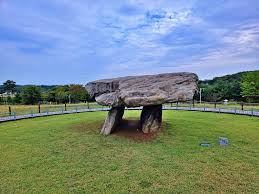
The Bugeun-ri dolmen (부근리 지석묘) ranks as Ganghwa’s largest and most famous dolmen, designated Korean Historic Site and serving as representative example of Korean megalithic architecture. The massive rectangular capstone measures approximately 7.1 meters long, 5.5 meters wide, and 0.5-1 meter thick, estimated to weigh 50-80 tons depending on density calculations.
This enormous capstone sits atop several support stones creating northern-style table dolmen clearly displaying the monumental engineering achievement involved in positioning such massive stone atop supports. The size indicates that whoever was buried here held exceptional social status warranting the most impressive burial monument the community could create.
The Bugeun-ri dolmen sits in the middle of modern agricultural fields, creating striking visual juxtaposition between prehistoric monument and contemporary rural landscape. This setting is actually archaeologically significant – the dolmen’s location in flat agricultural land suggests Bronze Age people also used these areas for farming, demonstrating landscape continuity where modern farmers work land that prehistoric farmers cultivated 3,000 years ago.
The site has minimal tourist facilities – just basic signage and small parking area – maintaining relatively natural setting where the dolmen itself remains the focus rather than being obscured by extensive visitor infrastructure. This simplicity allows contemplating the monument in landscape context similar to how prehistoric people would have encountered it.
Other Significant Ganghwa Dolmens
Gochangri Dolmens (고창리 지석묘):
This area contains multiple dolmens in close proximity, creating dolmen field or cluster. The concentration suggests this may have been important burial ground for Bronze Age elite clan or community. The variety of sizes and styles in close proximity allows comparing different dolmen types and construction approaches.
Samgeori Dolmens (삼거리 지석묘):
Another dolmen concentration with several well-preserved examples including both northern and southern-style dolmens. The diversity provides educational opportunity seeing construction variation within relatively small area.
Oepo-ri Dolmens (외포리 지석묘):
Coastal dolmens offering beautiful sea views combining prehistoric monuments with natural scenery. The coastal location raises interesting questions about prehistoric settlement patterns and whether these dolmens marked territorial boundaries along coastlines.
Many additional dolmens are scattered across Ganghwa in agricultural fields, forest edges, and hillsides. Some are well-maintained and marked, others are unmarked and might be overlooked without guidance. The total number (120+ confirmed) suggests many more may await discovery or identification.
UNESCO World Heritage Designation
UNESCO designated Ganghwa’s dolmens (along with dolmen sites in Gochang and Hwasun) as World Heritage in 2000, recognizing them as “the most representative types of dolmens found in the region” and praising how “the dolmen sites offer important evidence of how the megalithic culture developed.” The designation emphasized the exceptional density, diversity, and state of preservation of Korean dolmens compared to other megalithic cultures globally.
The UNESCO citation specifically noted that Korean dolmens “provide evidence for the existence of a highly developed social organization in prehistoric Korea” and demonstrate “the technical excellence achieved” in megalithic construction. The recognition validated Korean dolmens’ significance to world prehistory beyond just Korean national importance.
The designation brought international attention and modest tourism increase but didn’t transform Ganghwa into major tourist destination the way UNESCO designation affects some sites. The dolmens remain relatively undervisited by international tourists, though domestic visitors interested in Korean prehistory make deliberate trips to see them.
Ganghwa History Museum and Archaeological Context
The Ganghwa History Museum (강화역사박물관) in Ganghwa-eup provides essential archaeological and historical context for understanding the dolmens. The museum displays artifacts excavated from dolmens including pottery, stone tools, bronze implements, and human remains, bringing the abstract monuments to life through actual material culture from Bronze Age Ganghwa.
The museum explains dolmen construction techniques, shows models demonstrating how massive stones might have been moved and positioned, and provides broader context about Bronze Age Korean society, culture, and daily life. This educational content substantially enhances dolmen site visiting by providing interpretive framework that the sites themselves, with minimal signage, cannot offer.
The museum also covers Ganghwa’s later history including the island’s role during Goryeo Dynasty Mongol invasions (when Korean court fled to Ganghwa), Joseon Dynasty fortifications, and modern history. This comprehensive approach demonstrates how Ganghwa’s strategic location made it important across millennia, from prehistoric dolmen builders through contemporary times.
Pros of Ganghwa’s Dolmen Heritage
- Exceptional Density: The concentration of 120+ dolmens in relatively small island area creates unparalleled opportunity for studying Korean megalithic culture and seeing multiple examples efficiently.
- Variety: The presence of both northern and southern-style dolmens in various sizes provides comprehensive overview of Korean dolmen diversity impossible at sites with single dolmen type.
- UNESCO Recognition: World Heritage designation validates global significance and helps protect dolmens from development pressures and neglect.
- Accessible Location: Ganghwa’s proximity to Seoul (60-90 minutes) makes visiting realistic as day trip rather than requiring extensive travel to remote areas.
- Landscape Context: Many dolmens remain in relatively natural settings (agricultural fields, hillsides) allowing appreciation of monuments in landscape contexts similar to prehistoric placement.
Cons of Dolmen Site Visiting
- Limited Infrastructure: Most dolmen sites have minimal visitor facilities, signage, or interpretation, leaving visitors confused about what they’re seeing without advance research or guide.
- Scattered Distribution: The 120+ dolmens are spread across island rather than concentrated in single location, requiring transportation and navigation to see multiple examples.
- Visual Impact: Despite archaeological importance, dolmens appear as rough stones that many visitors find visually unimpressive compared to refined later Korean architecture and art.
- Context Dependence: Appreciating the dolmens requires substantial archaeological knowledge and imaginative engagement that casual tourists may lack or be unwilling to invest.
- Language Barriers: Most site signage and museum explanations are primarily Korean with limited English, creating access barriers for international visitors.
STELLA’S LOCAL SECRET
The “Multi-Dolmen Comparison Strategy”
Rather than visiting only famous Bugeun-ri dolmen, plan route visiting 4-5 different dolmen sites across Ganghwa representing different styles, sizes, and settings. This comparative approach reveals the diversity of megalithic construction and deepens understanding impossible from seeing single example.
Route suggestion: Start with Ganghwa History Museum for context, then visit Bugeun-ri (largest northern-style), Gochangri (dolmen cluster), and one or two smaller roadside dolmens. The progression from museum education to multiple concrete examples creates comprehensive learning experience.
Observation strategy: At each dolmen, observe and photograph specific features – capstone size and shape, support stone arrangement, setting in landscape, condition/preservation state. This systematic documentation creates comparative dataset revealing patterns and variations across dolmens.
Educational value: Seeing multiple dolmens transforms abstract archaeological concepts into concrete observable differences. You’ll genuinely understand what “northern style versus southern style” means through direct comparison rather than just reading definitions. The firsthand observation creates knowledge that textbook study cannot match.
Visiting Ganghwa Island: Practical Dolmen Tourism
Getting to Ganghwa Island from Seoul
Ganghwa Island sits approximately 60 kilometers northwest of Seoul in Incheon Metropolitan City, connected to mainland Korea by two bridges making it easily accessible by car or bus without ferry travel.
By Bus:
Express and local buses run from Seoul (particularly Sinchon area) to Ganghwa-eup taking approximately 90-120 minutes depending on traffic. Buses operate frequently throughout day. Once in Ganghwa-eup, local buses or taxi needed to reach specific dolmen sites scattered across island.
By Car:
Driving from Seoul takes 60-90 minutes via expressway and local roads, providing maximum flexibility for visiting multiple dolmen sites and other island attractions. GPS navigation works reliably for dolmen sites, though some minor sites may have limited address information.
Organized Tours:
Some tour companies offer day trips combining Ganghwa dolmens with other island attractions like temples, fortifications, and natural sites. Tours handle transportation but limit time at each location and reduce flexibility.
Navigating to Dolmen Sites
The major dolmen sites like Bugeun-ri have GPS addresses and appear on Korean mapping apps (Naver Maps, Kakao Maps) making navigation straightforward. However, many smaller dolmens are in agricultural fields or roadsides without formal addresses, requiring exploration and sometimes asking local residents for directions.
The Ganghwa Tourism Information Center in Ganghwa-eup provides maps showing dolmen locations and can offer guidance about which sites are most accessible and worth visiting. Staff may have limited English but usually can provide basic directions and maps.
Many dolmens are visible from roads passing through agricultural areas, making casual discovery possible while driving across the island. This serendipitous encountering of unexpected dolmens adds exploration element to systematic site visiting.
Best Times to Visit Ganghwa Dolmens
Season:
Spring (April-May) and autumn (September-November) offer comfortable weather for outdoor dolmen visiting. Summer can be hot and humid but brings lush green agricultural landscapes. Winter is cold but provides clear atmosphere and uncrowded conditions.
Day of Week:
Weekdays see fewer tourists than weekends, though Ganghwa dolmens never experience severe crowding compared to more popular tourist sites. The peaceful rural setting remains relatively quiet regardless of visiting time.
Time of Day:
Morning and late afternoon provide best natural lighting for photography. Midday harsh sunlight can create unflattering shadows on stones. The dolmens are accessible 24 hours (they’re in open fields) though visiting during daylight obviously recommended.
Combining Dolmen Tourism with Other Ganghwa Attractions
Ganghwa Goryeogung Palace Site (강화 고려궁지):
Historical site where Korean royal court resided during 13th-century Mongol invasions. Provides later historical context complementing prehistoric dolmen heritage.
Jeondeungsa Temple (전등사):
Beautiful Buddhist temple with historical buildings and serene mountain setting, offering spiritual and architectural interest contrasting with prehistoric dolmens.
Ganghwa Anglican Church (강화성공회성당):
Unique building combining Korean traditional architecture with Western church design, demonstrating Korean-Western cultural fusion during late Joseon period.
Ganghwa Peace Observatory (강화평화전망대):
Views across to North Korea from this border island location, providing perspective on Korean division and military tensions.
Ganghwa Tidal Flats (강화갯벌):
UNESCO World Heritage natural site (designated 2021) offering beautiful coastal ecosystems and traditional fishing culture experiences.
Manisan Mountain (마니산):
Sacred mountain with historical altar where legendary founder Dangun supposedly conducted rituals, connecting to ancient Korean foundation myths.
Pros of Ganghwa Island Visiting
- Proximity to Seoul: 60-90 minute travel time makes Ganghwa realistic day trip from Seoul requiring minimal travel investment.
- Diverse Attractions: The combination of prehistoric dolmens, historic temples, fortifications, natural sites, and cultural attractions creates multi-faceted destination beyond just dolmen tourism.
- Rural Atmosphere: The island’s agricultural character and lower tourist density provide peaceful, authentic experience contrasting with Seoul’s urban intensity.
- Historical Layers: Ganghwa’s strategic position created layered history from Bronze Age dolmens through Goryeo Dynasty, Joseon fortifications, and modern division era, allowing comprehensive Korean historical exploration.
Cons of Ganghwa Tourism
- Limited English: Most signs, maps, and explanations are Korean-language only, creating navigation and comprehension challenges for international visitors.
- Transportation Dependence: Without personal vehicle, reaching scattered dolmen sites and moving between island attractions requires coordination with limited bus service or expensive taxi usage.
- Minimal Facilities: Many dolmen sites have no visitor facilities, restrooms, or food/drink vendors, requiring self-sufficiency and advance planning.
- Specialized Interest: Dolmen appreciation requires specific archaeological or historical interest that general tourists may lack, limiting appeal to relatively niche cultural enthusiast audience.
STELLA’S LOCAL SECRET
The “Full Island Historical Journey”
Dedicate full day to Ganghwa exploring its layered history chronologically – start with Bronze Age dolmens, move to Goryeo Dynasty palace site, visit Joseon Dynasty fortifications and temples, end at Peace Observatory viewing North Korea. This temporal progression creates narrative showing Ganghwa’s continuing strategic importance across 3,000 years.
Why this works: The chronological structure transforms scattered attractions into coherent historical story revealing how geography shapes history. You’ll understand why this particular island attracted Bronze Age settlement, medieval Korean court, Joseon military installations, and remains militarily significant today.
Educational approach: At each site, consider how geographic features (island location, river access, views to mainland) influenced that period’s use of Ganghwa. The physical landscape becomes text revealing why human societies repeatedly found this location strategically valuable across millennia.
Cultural depth: The full-day comprehensive approach reveals patterns casual visitors miss – how each era adapted existing landscape for their needs, how later developments sometimes destroyed or incorporated earlier sites, and how contemporary Ganghwa preserves fragments from all these historical layers creating palimpsest landscape where different eras coexist visibly.
Frequently Asked Questions
Q: How long should I allocate for visiting Ganghwa dolmens?
For basic visit seeing famous Bugeun-ri dolmen and Ganghwa History Museum, allocate 2-3 hours. For comprehensive dolmen tourism visiting multiple sites, allocate half-day (4-5 hours). For full Ganghwa Island exploration combining dolmens with other attractions, allocate full day.
Q: Can I visit dolmens without personal vehicle?
Possible but challenging. Public bus reaches Ganghwa-eup from Seoul, but local transportation to scattered dolmen sites is limited. Taxi is necessary for visiting multiple sites without car. Organized tours provide transportation alternative but limit flexibility and visiting time.
Q: What makes Ganghwa’s dolmens special compared to other Korean dolmens?
Ganghwa has exceptional concentration (120+ dolmens in relatively small area), represents both northern and southern construction styles, includes Korea’s largest dolmen (Bugeun-ri), and offers proximity to Seoul making them most accessible major dolmen concentration for tourists.
Q: Is visiting dolmens interesting for children?
Older children interested in history or archaeology may find dolmens fascinating. Young children may enjoy climbing on stones (where permitted) but might find prehistoric monuments boring without engaging interpretation or activities. The outdoor rural setting allows running and playing more than indoor museums.
Q: How does visiting Ganghwa dolmens compare to visiting Stonehenge or other famous megalithic sites?
Korean dolmens lack Stonehenge’s unified monumental scale and dramatic circular arrangement, but Ganghwa offers opportunity to see many individual monuments in rural settings without excessive tourist development, crowds, or access restrictions. The experience is more intimate and exploratory versus Stonehenge’s controlled, crowded environment.
Q: Can I touch the dolmens?
Generally yes – most dolmens are in open fields without barriers, allowing tactile interaction. However, climbing on dolmens, moving stones, or damaging monuments is obviously prohibited and disrespectful. Appropriate touching for scale appreciation versus destructive interaction requires common sense and cultural sensitivity.
Q: Why are dolmens just rough stones rather than refined architecture?
Dolmens were built with Bronze Age technology lacking metal tools effective for precise stone cutting and shaping. Builders selected naturally appropriate stones requiring minimal modification rather than extensively quarrying and shaping stones. The “roughness” reflects technological limitations and practical construction approaches, not lack of care or skill.
Q: What was found inside the dolmens?
Archaeological excavations have discovered human skeletal remains, pottery vessels, stone tools, bronze implements, and occasionally ornamental items like jade beads. These grave goods provide evidence about Bronze Age Korean material culture, burial practices, and social differentiation.
Q: Can I visit all 120+ dolmens on Ganghwa?
Theoretically yes, but practically unrealistic. Many dolmens are on private agricultural land, unmarked, or accessible only with local knowledge. Most visitors see 3-5 major marked dolmen sites, which provides representative sampling of Ganghwa’s megalithic heritage.
Q: Is there English signage at dolmen sites?
Minimal. Major sites like Bugeun-ri have basic English signs, but many smaller sites have Korean-only or no signage. Advance research and/or Korean-speaking guide significantly enhance understanding and ability to locate and interpret sites.
Touching Korea’s Prehistoric Past
You now have comprehensive knowledge to visit Ganghwa Island’s dolmens with deep understanding of what makes these prehistoric monuments significant to Korean archaeology and global megalithic studies. You’ve learned what dolmens are, how Bronze Age people constructed them with remarkable engineering despite limited technology, and what they reveal about prehistoric Korean social organization and beliefs.
You understand why Ganghwa Island contains Korea’s greatest dolmen concentration and what makes these megalithic monuments globally significant enough for UNESCO World Heritage designation. You know which dolmen sites to prioritize, how to reach and navigate to scattered sites, and how to combine dolmen tourism with Ganghwa’s other historical and natural attractions.
Most importantly, you understand that these rough stones aren’t merely old rocks but tangible connections to Korea’s prehistoric past – evidence of human societies that left no written records but created monuments that have outlasted everything else from Bronze Age Korea. Every dolmen represents enormous communal labor, sophisticated technical knowledge, and profound beliefs about death, status, and permanence that motivated people to move massive stones creating monuments they knew would outlast their own brief lives.
Ganghwa’s dolmens await in fields and hillsides where they’ve stood for 3,000 years. The massive stones still rest where Bronze Age people positioned them with technologies we can barely imagine. The monuments still speak silently about human ambition, mortality, and the drive to leave permanent marks on landscapes we briefly inhabit. Your encounter with Korea’s prehistoric heritage is about to begin.