
500 Years of Royal Burial Tradition
Have you ever wanted to experience sacred spaces where Korea’s kings and queens rest for eternity in burial grounds designed according to principles that blend Confucian ritual, geomantic wisdom, and architectural beauty? Where UNESCO recognizes not individual tombs but an entire system of 40 royal burial sites preserving 500 years of continuous dynastic tradition? Where you can walk paths lined with stone guardians, witness elaborate ritual architecture, and understand how Korean culture approached death, commemoration, and the proper treatment of royal ancestors? Where the boundaries between nature and culture blur in landscapes carefully crafted to honor the dead while bringing peace to the living? The Joseon Royal Tombs offer exactly this experience – but only if you understand the Confucian principles governing royal burial, appreciate the sophisticated geomantic site selection creating harmonious tomb locations, know which tombs to visit among the 40 scattered across Seoul and Gyeonggi Province, and grasp why these burial grounds represent not just death monuments but profound expressions of Korean cultural values about hierarchy, remembrance, and humanity’s relationship with landscape.
Most visitors approach the royal tombs as pleasant park-like settings for weekend walks, enjoying the peaceful forested landscapes without understanding the elaborate symbolism, careful planning, and continuing ritual significance that make these spaces far more than beautiful nature areas. They photograph the distinctive burial mounds and stone statues but miss the geomantic calculations that determined every tomb’s precise location and orientation. They walk the spirit paths without knowing the Confucian protocols that dictated every architectural element’s placement and meaning. They visit during casual weekend outings without realizing that royal descendants still conduct annual ancestor worship ceremonies maintaining 500-year-old traditions.
I understand that superficial engagement completely. My first royal tomb visit was casual walk through Seolleung (near Gangnam), enjoying the peaceful forest atmosphere and photographing interesting stone statues without any real understanding of what I was seeing or why it mattered. The tomb seemed like pleasant urban park rather than sacred cultural landscape encoding centuries of Korean beliefs about death, kingship, and proper commemoration.
That’s why this comprehensive guide exists. I’m going to share everything you need to transform royal tomb visiting from pleasant nature walks into meaningful encounters with Korean cultural traditions about death, remembrance, and the proper treatment of royal ancestors. You’ll learn the Confucian principles and geomantic theories that governed every aspect of royal tomb design and location. You’ll understand the symbolic significance of every architectural element from burial mounds to stone statues to ritual buildings. You’ll discover which tombs to prioritize among the 40 UNESCO-designated sites, how to visit them efficiently, and what makes certain tombs historically or architecturally significant. You’ll gain insight into why these burial grounds still matter to contemporary Koreans and why UNESCO recognized them as representing “exceptional architectural, artistic, and landscape values.”
By the end of this guide, you’ll know how to visit Joseon royal tombs with understanding that transforms peaceful forests into landscapes deliberately shaped by human hands according to sophisticated cultural principles, simple burial mounds into carefully calculated expressions of geomantic wisdom, and stone statues into guardians whose placement and orientation follow precise ritual protocols. You’ll appreciate why UNESCO designated these tombs despite Korea having older royal burials and more elaborate architectural monuments. You’ll understand what makes the Joseon royal tomb system unique as 500-year continuous tradition preserving consistent principles across dynastically changing circumstances. Most importantly, you’ll grasp why these sacred landscapes represent Korean culture at its most refined, demonstrating how death, nature, architecture, and ritual can combine creating spaces that serve both spiritual and aesthetic purposes.
Understanding Joseon Royal Tombs: Cultural and Historical Context
The Joseon Dynasty and Royal Succession
The Joseon Dynasty ruled Korea from 1392 to 1910, spanning over 500 years and 27 kings across multiple generations of the Yi royal family. This remarkable longevity created the longest-ruling Confucian dynasty in East Asian history, establishing cultural and governmental systems that fundamentally shaped Korean identity and continue influencing contemporary Korean society.
During these five centuries, the royal family buried their deceased kings, queens, crown princes, and other royal family members in tombs constructed according to strict protocols derived from Chinese precedents but adapted to Korean circumstances, beliefs, and landscape. The resulting 40 royal tombs (housing 44 kings and queens plus additional royal family members) create unparalleled record of dynastic burial practices maintained with remarkable consistency across half a millennium.
The tombs weren’t merely burial sites but sacred spaces requiring continuing ritual maintenance, regular ceremonies, and permanent staff dedicated to tomb upkeep and ancestor worship. Each tomb essentially functioned as permanent temple to deceased royalty, with the landscape, architecture, and ritual practices all designed to properly honor royal ancestors according to Confucian principles of filial piety extended across generations.
Confucian Principles in Royal Burial
Confucianism dominated Joseon Dynasty ideology, establishing philosophical frameworks governing everything from government administration to family relationships to death rituals. For royal burials, several key Confucian principles shaped tomb design and management:
Filial Piety (효/孝, hyo):
The fundamental Confucian virtue requiring children to honor parents and, by extension, descendants to honor all ancestors. Royal tombs represented ultimate expression of filial duty, with reigning kings dedicating enormous resources to creating proper burial places for deceased royal family members and maintaining ongoing ancestor worship ceremonies demonstrating continuing devotion.
Ritual Propriety (예/禮, ye):
Confucianism emphasized following proper ritual forms for all important life events, with funerals and ancestor worship receiving particular attention. Every aspect of royal tomb construction followed detailed ritual protocols specifying correct procedures, architectural forms, and ceremonial practices ensuring propriety was maintained.
Social Hierarchy (명분/名分, myeongbun):
Confucian society organized through strict hierarchical relationships requiring everyone to understand and accept their proper social position. Royal tombs expressed ultimate social hierarchy, with elaborate architectural programs demonstrating that even in death, kings occupied supreme social position requiring monuments far exceeding anything permitted for commoners or even aristocrats.
Harmony with Nature:
While primarily Chinese philosophy, Confucianism incorporated elements of Daoist naturalism emphasizing harmony between human activity and natural environment. Royal tombs exemplified this principle through careful site selection and landscape design creating burial grounds that appeared to grow naturally from their surroundings rather than imposing rigid geometric patterns on natural topography.
Geomancy (Pungsu) and Site Selection
Korean geomancy (풍수/風水, pungsu, identical to Chinese fengshui) played crucial role in royal tomb site selection. Geomantic theory holds that landscape features create energy flows (기/氣, gi or qi) that can be auspicious or inauspicious depending on configuration. Proper site selection means finding locations where natural energy flows create beneficial conditions for the deceased’s spirit and the living descendants.
Geomantic site evaluation considers multiple factors:
Mountain and Water Configuration:
Ideal sites have protective mountains behind and to sides creating sheltered embrace, with water flowing in front creating openness and providing positive energy flow. The term “배산임수” (baesan-imsu, “mountain at back, water in front”) summarizes this preferred configuration.
Directional Orientation:
Geomancy considers cardinal directions and their associated elements, with some orientations considered more auspicious than others. Tombs are typically oriented southward (considered most auspicious direction associated with fire element, life, and yang energy).
Energy Flow Patterns:
Geomancers study how energy (gi) flows through landscape following ridgelines, valleys, and watercourses. They identify “dragon vein” (용맥/龍脈, yongmaek) energy paths and locate tombs at points where beneficial energy accumulates or can be tapped.
Visual Harmony:
Beyond abstract energy concepts, geomancy also considers aesthetic factors, seeking sites that create visual balance and beauty. The geomantic preference for sites embraced by mountains naturally produces visually pleasing locations.
For royal tombs, geomantic site selection became extremely important with royal geomancers carefully surveying potential locations, evaluating energy configurations, and recommending optimal sites. The process could take months or even years as geomancers debated the merits of different locations. Once selected, the exact positioning of burial mound, buildings, and pathways followed further geomantic calculations ensuring every element aligned properly with energy flows.
Architectural Elements of Royal Tombs
Joseon royal tombs follow consistent architectural programs combining natural landscape with built elements creating sacred spaces that are simultaneously functional burial sites and symbolic representations of royal authority, Confucian values, and geomantic principles.
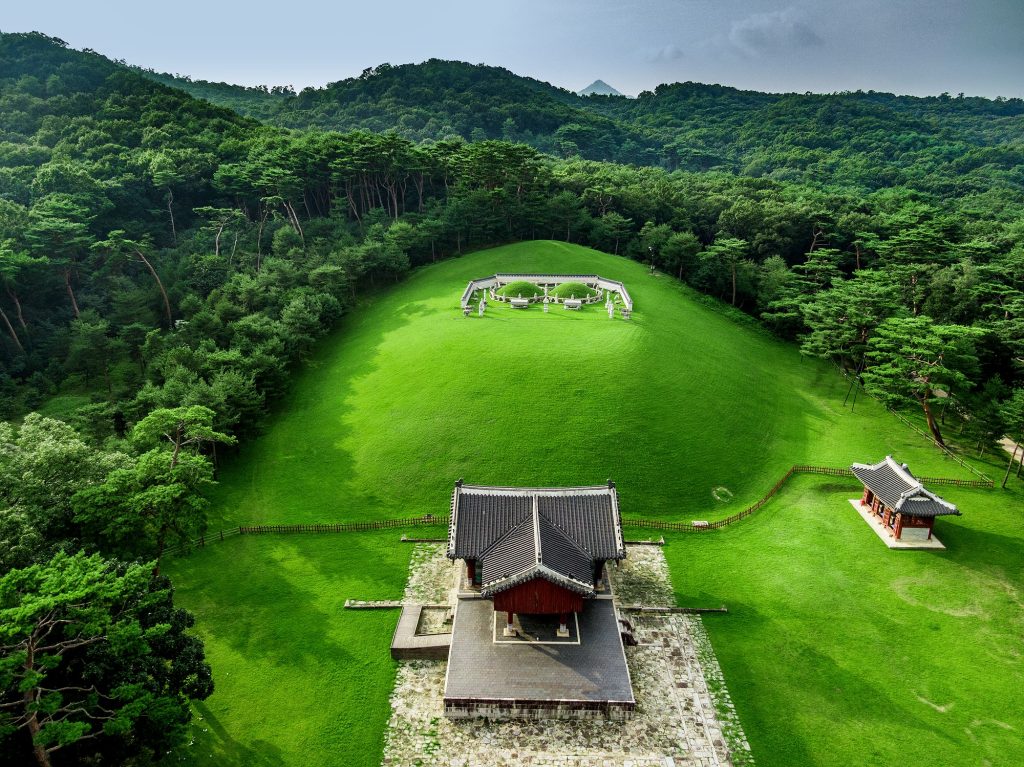
The Burial Mound (봉분/封墳):
The distinctive rounded earth mound covering the burial chamber represents the tomb’s most visible feature. These mounds vary in size but typically stand 3-5 meters tall with diameter of 10-15 meters, large enough to dominate the landscape while maintaining proportional relationship with surrounding terrain. The mounds are covered in grass creating green hillocks that blend naturally with forested settings.
Stone Chambers:
Beneath the burial mounds, stone-lined chambers contain the deceased royal’s remains placed in coffin along with various grave goods. These underground chambers were sealed after burial and theoretically never reopened, making them archaeologically pristine time capsules.
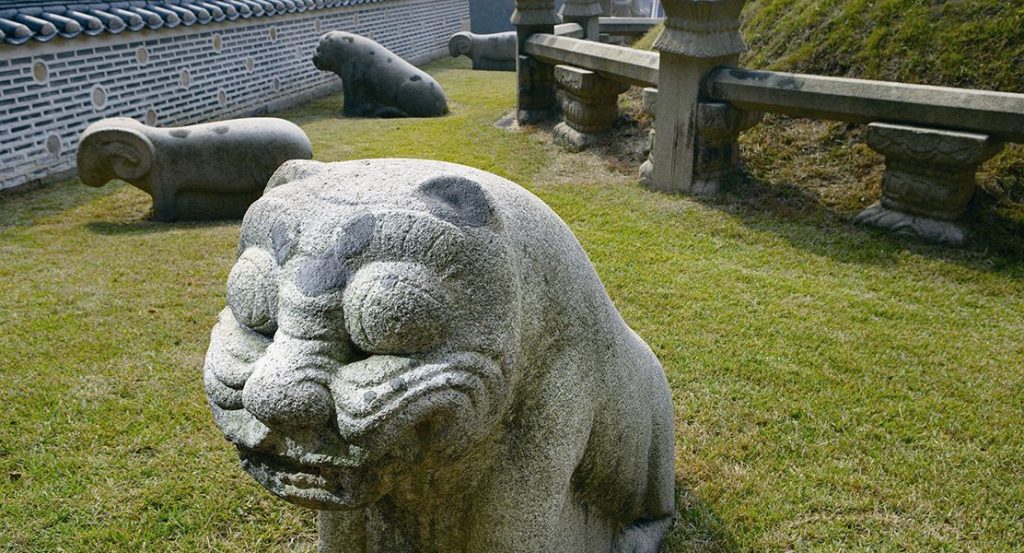
Stone Statues (석물/石物):
The spirit paths leading to burial mounds feature elaborate stone statue programs depicting civil and military officials, horses, sheep, tigers, and mythical guardians. These statues represent royal court assembled to honor deceased king, with the animal statues symbolizing various virtues and protective qualities. The statues face toward the tomb, eternally attending the buried royal.
Ritual Buildings:
Each tomb complex includes several wooden buildings: the Jeongjagak (정자각/丁字閣), a T-shaped building where ancestor worship ceremonies occur; the Suragan (수라간/水刺間), where ritual food was prepared; and various auxiliary structures for tomb maintenance staff.
Spirit Path and Sacred Road:
A carefully planned pathway leads from entrance through the tomb complex to the burial mound. This path divides into two parallel routes – one for spirits and one for living visitors – reflecting belief that spirits of deceased royalty continue inhabiting the tomb and require appropriate access paths.
Red Spiked Gate (홍살문/紅箭門):
The distinctive red gate with spiked top marks transition from secular world to sacred tomb space. Passing through this gate means entering spiritually significant area requiring respectful behavior and proper ritual conduct.
Personal Story: Understanding Through Seasonal Visiting
I’ve visited Donggureung (the largest royal tomb complex) during all four seasons, and each visit revealed different aspects of the tomb landscape that single-season visiting cannot capture. Spring cherry blossoms create almost festive atmosphere contrasting with the tombs’ memorial function. Summer’s lush greenery demonstrates how carefully planned forest management creates natural appearance through constant human intervention. Autumn foliage transforms the landscape into visual spectacle where aesthetic and spiritual dimensions merge seamlessly. Winter’s bare trees reveal the underlying landforms and architectural structures that forest cover obscures during other seasons.
An elderly tomb keeper I encountered during winter visit explained that seasonal changes weren’t incidental but were intentionally part of the tomb experience. “The royal tombs should reflect the natural cycles of death and renewal,” he said. “Spring shows new life emerging from death. Summer shows abundance and vitality. Autumn shows beauty in decay. Winter shows the reality of death before spring renewal begins again. The tombs teach that death is part of natural order, not something to fear.”
His words revealed that the tombs function as living landscapes teaching lessons about mortality, cycles, and humanity’s place within natural order. They’re not static monuments but dynamic spaces changing with seasons, weather, and time, embodying Korean cultural wisdom about accepting impermanence while honoring memory.
Pros of Understanding Royal Tomb Culture
- Cultural Insight: Understanding Confucian principles, geomantic theories, and ritual practices transforms tomb visiting from pleasant nature walks into profound cultural education about Korean beliefs regarding death, hierarchy, and commemoration.
- Architectural Appreciation: Learning to recognize and interpret standard tomb elements (burial mounds, stone statues, ritual buildings, spirit paths) creates framework for understanding any Joseon royal tomb regardless of specific location or occupant.
- Historical Connection: The 500-year span of Joseon Dynasty tombs creates chronological progression allowing observation of cultural continuity and subtle changes across generations of royal burials.
- Landscape Aesthetics: Appreciating the geomantic site selection and deliberate landscape design reveals how these tombs achieve remarkable integration of architecture with nature that appears natural despite being highly calculated.
- UNESCO Validation: World Heritage designation confirms these tombs’ global significance as representing exceptional continuous cultural tradition worthy of international recognition and protection.
Cons of Tomb Complexity
- Intellectual Demands: Full appreciation requires understanding Confucianism, geomancy, Korean history, royal genealogy, and traditional architecture – substantial knowledge base that casual tourists typically lack.
- Scattered Locations: The 40 tombs are distributed across Seoul and Gyeonggi Province rather than concentrated in single location, requiring multiple trips to see representative selection.
- Visual Similarity: All royal tombs follow similar architectural programs, creating potential monotony where visitors familiar with one tomb find others repetitive despite subtle individual variations.
- Limited Access: Many tomb areas restrict visitor access protecting fragile grass-covered mounds and maintaining sacred atmosphere, preventing close examination of architectural details.
STELLA’S LOCAL SECRET
The “Comparative Architecture Study”
Rather than visiting single tomb complex, plan day visiting 2-3 different royal tomb sites representing different eras, scales, and configurations. This comparative approach reveals both the consistent principles underlying all royal tombs and the subtle variations reflecting individual circumstances, geomantic conditions, and chronological changes.
Recommended comparison route: Visit Seonjeongneung (small urban tomb), Donggureung (large complex with 9 tombs), and Gwangneung (secluded forest tomb). These three represent different scales, settings, and historical periods, creating comprehensive overview of royal tomb diversity within consistent traditional framework.
Observation strategy: At each tomb, photograph the same architectural elements (burial mound, stone statues, ritual building, spirit path) from similar angles and distances. This systematic documentation creates visual dataset revealing patterns and variations that casual visiting without comparative structure wouldn’t expose.
Educational value: The comparative approach transforms abstract architectural principles into concrete observable differences. You’ll genuinely understand concepts like “geomantic site selection” and “ritual architectural program” through direct comparison rather than just reading definitions in guidebooks.
Major Royal Tomb Sites: Where to Visit
Donggureung (동구릉): The Largest Royal Tomb Complex
Donggureung in Guri city (eastern Gyeonggi Province) represents the largest Joseon royal tomb complex, containing nine separate tombs including Taejo (Joseon Dynasty founder) and several later kings and queens. The name literally means “Nine Eastern Tombs” (동구릉/東九陵) indicating both the location east of Seoul and the number of burial sites.
Taejo’s tomb (건원릉/Geonwolleung) holds special significance as the dynasty founder’s burial place, receiving particular veneration and maintenance throughout Joseon Dynasty and continuing today. The tomb demonstrates the fully developed Joseon royal tomb architectural program that later burials would follow with variations.
Donggureung’s scale allows extended walking through beautiful forested landscapes where multiple tomb complexes nestle in valleys and hillsides selected for optimal geomantic conditions. The site demonstrates how royal family managed multiple royal burials within single general area while maintaining individual tomb integrity and proper geomantic positioning for each.
Visiting advantages:
- Multiple tombs in single location allow efficient touring and comparative observation
- Well-maintained paths and facilities support comfortable extended visiting
- Forest setting creates peaceful contemplative atmosphere despite proximity to urban Guri
- Educational exhibits explain royal tomb culture and specific historical contexts
Visiting challenges:
- Distance from central Seoul (40-50 km) requires deliberate trip planning
- Large size means visiting all nine tombs thoroughly requires 3-4 hours
- Popular weekend destination sees substantial crowds during pleasant weather
Seonjeongneung (선정릉): Urban Royal Tombs
Seonjeongneung in Seoul’s Gangnam district demonstrates how royal tombs function in contemporary urban contexts, surrounded by modern office buildings and apartment towers yet maintaining sacred character through careful preservation. The complex contains tombs of King Seongjong, Queen Jeonghyeon, and King Jungjong from mid-Joseon period.
The urban setting creates fascinating juxtaposition between ancient sacred landscape and modern commercial development, raising questions about heritage preservation in densely developed cities. The tomb grounds function as urban forest providing recreational and spiritual spaces for nearby residents while maintaining ritual significance.
Visiting advantages:
- Central Seoul location (Gangnam) makes access extremely convenient via subway
- Relatively compact allows thorough visiting in 1-2 hours
- Urban context creates interesting contrast highlighting royal tomb persistence across centuries
- Peaceful forest atmosphere provides escape from surrounding urban intensity
Visiting challenges:
- Urban noise and visible modern buildings diminish sense of entering timeless sacred space
- Smaller scale means fewer architectural elements and less extensive walking paths
- Popularity as urban park attracts casual visitors more interested in exercise than cultural heritage
Gwangneung (광릉): The Forest Tomb
Gwangneung in Pocheon (northern Gyeonggi Province) occupies particularly beautiful forested hillside, with the tomb complex nestled in mature forest that has been protected for over 500 years. The extensive forest (Gwangneung Forest) surrounding the tomb became Korea’s first designated forest reserve and supports rich biodiversity including rare species.
The tomb belongs to King Sejo (7th Joseon king) whose controversial reign included political conflicts and usurpation but who also strongly supported Buddhism despite Confucian state ideology. Sejo’s tomb reflects some unique features related to his Buddhist sympathies and his instructions for simpler burial than typical royal tombs.
Visiting advantages:
- Spectacular natural setting in mature protected forest creates particularly peaceful atmosphere
- Forest itself is significant ecological and historical site beyond just the royal tomb
- Less crowded than Donggureung or Seonjeongneung allows quiet contemplation
- Cooler temperatures in forest provide summer visiting comfort
Visiting challenges:
- Remote location (50+ km from Seoul) requires significant travel time and planning
- Limited public transportation means personal vehicle or taxi necessary
- The extensive forest means substantial walking on sloped terrain
Jeongneung (정릉): Seoul’s Northern Royal Tomb
Jeongneung near Seongbuk-dong in northern Seoul provides accessible urban royal tomb with less commercial surroundings than Seonjeongneung. The tomb contains Queen Sindeok (King Taejo’s second wife), with location selected after geomantic considerations and political factors influenced by her sons’ power struggles after Taejo’s death.
The site demonstrates how political circumstances could affect tomb placement, with Queen Sindeok buried separately from her husband (Taejo at Donggureung) due to court politics and her sons’ eventual loss of power struggle. This separation from her husband violated ideal Confucian practice but reflected practical political realities.
Visiting advantages:
- Seoul location with good subway access makes visiting convenient
- Less crowded than Seonjeongneung despite urban setting
- Residential neighborhood setting creates more peaceful atmosphere than Gangnam commercial area
- Clear example of how politics influenced tomb site selection
Visiting challenges:
- Single tomb means less extensive complex than Donggureung
- Neighborhood location lacks grand forest setting of suburban tombs
- Limited English signage compared to major tourist-oriented sites
Heolleung-Yeolleung (헌릉·인릉): Scholarly Kings
This tomb complex in Seoul’s Seocho district contains tombs of King Taejong and Queen Wongyeong (Heolleung) and King Sunjo and Queen Sunwon (Ineung). King Taejong was particularly significant as effective administrator who strengthened royal authority and rationalized government, though his reign included controversial political purges.
The tombs demonstrate late Joseon refinements to royal tomb architecture and landscape integration, with particularly well-preserved stone statue programs and ritual buildings. The forest setting despite urban surroundings creates peaceful environment for understanding royal tomb culture.
Visiting advantages:
- Seoul location with reasonable access
- Two significant royal couples create comparative opportunity
- Well-maintained facilities and paths
- Educational materials explain historical contexts
Visiting challenges:
- Less famous than Donggureung or Seonjeongneung means less comprehensive visitor resources
- Moderate distance from central Seoul requires dedicated trip
- Limited English interpretation
Pros of Major Site Visiting
- Architectural Completeness: Major sites maintain full royal tomb architectural programs with burial mounds, stone statues, ritual buildings, and forest settings creating comprehensive cultural experience.
- Educational Resources: Popular sites provide visitor centers, multilingual explanations, and knowledgeable staff who can answer questions and provide context.
- Accessibility: Major sites have good transportation access, maintained paths, and facilities supporting comfortable extended visiting.
- Historical Significance: Major sites typically contain historically important royalty whose lives and reigns connect to significant events making tomb visiting more meaningful.
Cons of Major Site Logistics
- Distance: Even “convenient” sites require 30-60 minutes travel from central Seoul, with remote sites requiring 1-2 hours.
- Time Consumption: Thorough visiting of single tomb complex requires 1-3 hours, with multiple site touring consuming full day or requiring multiple separate trips.
- Crowds: Popular sites during pleasant weather (spring, autumn weekends) see substantial crowds diminishing the peaceful contemplative atmosphere tombs were designed to provide.
- Limited Differentiation: After visiting 2-3 royal tombs, architectural similarity and consistent landscape approaches can make additional tomb visiting feel repetitive.
STELLA’S LOCAL SECRET
The “Seasonal Ritual Ceremony Attendance”
Check royal tomb ceremony schedules (particularly at Jongmyo Shrine and major tomb sites) and plan visiting to coincide with traditional ancestor worship ceremonies (jerye/제례) when royal descendants conduct Confucian rituals honoring deceased kings. These ceremonies, held annually at major tombs, provide living encounter with 500-year-old ritual traditions rarely visible to casual visitors.
Why this works: The ceremonies demonstrate that royal tombs aren’t just historical monuments but continuing sacred spaces where traditional practices are actively maintained. You’ll witness elaborate Confucian rituals including formal dress, prescribed movements, ritual music, and food offerings performed exactly as they have been for centuries.
Cultural respect: If attending ceremonies, maintain respectful distance, quiet behavior, and no photography during actual ritual proceedings unless explicitly permitted. Your respectful observation honors both the ritual and the descendants maintaining these traditions.
Educational value: Seeing actual ritual performance provides context that transforms subsequent tomb visiting. You’ll understand that every architectural element you see was designed to support these ceremonies, and the tombs were conceived as permanent ritual spaces rather than merely memorial markers.
Practical Planning for Royal Tomb Visiting
Getting to Royal Tomb Sites
Royal tomb access varies significantly depending on location:
Urban Tombs (Seonjeongneung, Jeongneung):
Seoul subway provides direct access with stations within 10-15 minute walk of tomb entrances. These sites are highly accessible for tourists using public transportation.
Suburban Tombs (Donggureung, Gwangneung, others):
Require combination of subway to outer Seoul stations plus local bus or taxi to actual tomb sites. Public transportation is possible but requires coordination and can involve 1-2 hours travel each way from central Seoul.
Personal Vehicle:
Provides maximum flexibility for visiting multiple tombs in single day trip and reaching remote sites with limited public transportation. GPS navigation works reliably for all designated tomb sites.
Operating Hours and Admission
Royal tombs typically operate year-round with seasonal hours:
- Summer (March-October): 6:00 AM – 6:30 PM
- Winter (November-February): 6:00 AM – 5:30 PM
Admission costs vary by site but typically:
- Adults: 1,000 won
- Youth/Elderly: 500 won
- Children: Free
These remarkably low fees reflect Korean cultural policy making heritage accessible rather than treating royal tombs as premium tourism products. Many locals visit tombs regularly as neighborhood parks for exercise and relaxation.
What to Bring and Wear
Comfortable Walking Shoes:
Essential for extended walking on forest paths, some with moderate slopes and occasional stairs. The peaceful atmosphere encourages slow contemplative walking making comfort important.
Weather-Appropriate Clothing:
Tombs are outdoor sites with limited shade or shelter. Summer requires sun protection and light clothing. Winter requires warm layers as forest locations can be significantly colder than urban areas. Rain gear necessary during uncertain weather.
Respect for Sacred Space:
While tombs don’t enforce strict dress codes, modest clothing shows cultural respect. The tombs remain sacred spaces for many Koreans conducting ancestor worship or spiritual contemplation.
Best Times to Visit
Season:
Spring (April-May) brings beautiful cherry blossoms and fresh greenery. Autumn (October-November) offers spectacular foliage. Summer provides lush forests but involves heat and humidity. Winter offers solitude and stark beauty but cold temperatures.
Day of Week:
Weekdays see fewer visitors than weekends, with Tuesday-Thursday typically quietest. Weekend mornings before noon provide better experience than midday/afternoon peak times.
Time of Day:
Early morning (6:00-9:00 AM) provides cool temperatures, beautiful light, smallest crowds, and opportunity to observe regular local visitors using tombs for morning exercise and meditation.
Combining Multiple Tombs
For dedicated tomb enthusiasts or visitors with multiple Seoul days, planning routes visiting several tombs in single day maximizes cultural experience:
Eastern Route: Donggureung + Gwangneung (both eastern/northern Gyeonggi Province) Seoul Route: Seonjeongneung + Jeongneung + Heolleung-Yeolleung (all Seoul) Western Route: Seolleung + Taeneung (Seoul/Gyeonggi border)
Each route requires full day with personal vehicle or willingness to coordinate complex public transportation transfers.
Pros of Strategic Planning
- Efficiency: Good planning maximizes cultural experience minimizing wasted travel time and allowing optimal site touring during best times.
- Cost-Effectiveness: The minimal admission fees and good public transportation to urban tombs make royal tomb visiting extremely economical cultural activity.
- Flexibility: Extended operating hours and year-round access allow visiting during optimal times avoiding crowds and uncomfortable weather.
- Combined Value: Visiting multiple tombs in single day creates comparative understanding and comprehensive appreciation of royal tomb traditions.
Cons of Visit Planning
- Time Investment: Even accessible urban tombs require 2-3 hour blocks including travel, with comprehensive tomb touring consuming full days.
- Transportation Complexity: Suburban and remote tombs require complex public transportation coordination or personal vehicle reducing spontaneity.
- Weather Dependency: As outdoor sites, royal tombs are significantly affected by weather conditions, requiring flexible planning or accepting potential discomfort.
- Limited Interpretation: Many sites have minimal English signage or explanation, requiring advance research or Korean language ability for full understanding.
STELLA’S LOCAL SECRET
The “Local Morning Exercise Integration”
Visit royal tombs at 6:00-7:00 AM when they open, joining local residents who use tomb grounds for morning exercise, meditation, and quiet reflection. This early hour provides nearly solitary tomb experience impossible during normal tourist hours while allowing observation of how royal tombs function as living community spaces beyond just tourist attractions.
Why this works: You’ll experience tombs as local Koreans do – as peaceful forest sanctuaries providing spiritual and recreational value rather than merely historical sites. The absence of tourist crowds allows genuine contemplation and detailed observation of architectural elements.
Cultural benefit: Early morning visitors are typically older Korean residents with genuine interest in history and traditional culture. They’re often willing to share knowledge with respectful foreign visitors, creating informal cultural exchange opportunities impossible during crowded tourist hours.
Photography advantage: Morning light is optimal for forest photography, creating long shadows and soft illumination highlighting architectural details. The quiet atmosphere allows patient photography without crowds intruding into frames.
Frequently Asked Questions
Q: How many royal tombs should I visit to understand the tradition?
Two or three tombs representing different scales and settings provide sufficient understanding. Recommended minimum: one major complex (Donggureung), one urban tomb (Seonjeongneung), creating comparative perspective on scale and context.
Q: Can I visit royal tombs without knowing Korean history?
Yes, though historical knowledge significantly enhances appreciation. The architectural elements, forest settings, and ritual spaces remain impressive even without detailed historical context, but knowing which king/queen is buried and their historical significance adds meaningful dimension.
Q: Are there English tours or audio guides?
Major sites (Donggureung, Seonjeongneung) have basic English information and sometimes English-language brochures. Professional English guided tours are rare. Audio guide apps may be available at some sites but aren’t consistently offered across all tomb locations.
Q: Can I bring food and have picnic at royal tombs?
Generally no. While tombs are park-like, they remain sacred spaces where eating and drinking (except water) is discouraged or prohibited. Picnic facilities if present are typically located outside the actual tomb areas.
Q: Are royal tombs suitable for children?
Older children interested in history will find tombs educational. Young children may enjoy the forest setting and stone statues but might find extended walking and historical content boring. The outdoor setting allows running and movement more than indoor museums.
Q: How do royal tombs compare to Chinese or Japanese royal burial sites?
Korean royal tombs emphasize integration with natural landscape more than Chinese imperial tombs’ monumental scale or Japanese imperial tombs’ ritual simplicity. Korean tombs represent distinctive aesthetic balancing architectural elaboration with natural forest settings.
Q: Can I see inside the burial chambers?
No. The chambers are sealed and have never been opened since original burials, maintaining them as pristine archaeological sites. Only the exterior mounds and above-ground architectural elements are accessible to visitors.
Q: What’s the best single tomb for limited time?
Seonjeongneung (Gangnam) offers best combination of accessibility, representative architecture, adequate scale, and reasonable touring time (1-2 hours). It’s not the largest or most historically significant but provides excellent introduction to royal tomb culture with minimal logistical challenges.
Q: Are there still royal family descendants?
Yes, though they hold no political power or royal status. Some descendants maintain interest in preserving royal tomb culture and occasionally participate in traditional ancestor worship ceremonies at significant tombs.
Q: Why are the tombs called “tombs” rather than “mausoleums”?
The Korean term 능/陵 (neung) translates as “royal tomb” or “mausoleum.” “Tomb” is used in English to maintain consistency with “royal tomb” terminology established in UNESCO designation and Korean tourism materials, though “mausoleum” might more accurately convey the monumental, elaborate character distinguishing royal burials from common graves.
Walking Through 500 Years of Royal Memory
You now have comprehensive knowledge to visit Joseon royal tombs with deep understanding of what makes these burial grounds globally significant UNESCO World Heritage sites. You’ve learned the Confucian principles, geomantic theories, and ritual practices that governed every aspect of royal tomb design and site selection. You understand the architectural elements and their symbolic meanings, transforming what appear to be simple forest parks into sophisticated sacred landscapes encoding centuries of Korean cultural values.
You know which royal tomb sites to prioritize among the 40 scattered across Seoul and Gyeonggi Province, how to access them efficiently, and what makes certain tombs historically or architecturally noteworthy. You’ve gained strategies for visiting during optimal times, combining multiple tombs, and experiencing these sites as both tourist attractions and continuing sacred spaces.
Most importantly, you understand that Joseon royal tombs represent more than historical curiosities or pleasant walking destinations. They embody Korean cultural genius at creating spaces that simultaneously serve practical burial functions, express religious and philosophical values, demonstrate technological and artistic achievement, and create lasting beauty through harmonious integration of architecture with nature. These tombs have survived wars, invasions, colonization, and modernization precisely because they transcend their original purpose as royal burial grounds to become timeless expressions of humanity’s struggle to honor the dead, remember the past, and create meaning from mortality.
The Joseon royal tombs await in forests across Seoul and beyond. Stone guardians still stand eternal vigil. Burial mounds still rise from carefully tended grass. Spirit paths still lead through pine forests toward the resting places of kings and queens who ruled Korea centuries ago. Your encounter with 500 years of royal memory is about to begin.