
Korea’s Buddhist Architectural Masterpiece
Have you ever wanted to experience a place where 8th-century Buddhist architecture reaches its absolute pinnacle? Where UNESCO recognizes not just historical significance but artistic perfection embodied in stone pagodas, bronze statues, and architectural harmony? Where ancient Korean craftsmen created structures so mathematically precise and aesthetically balanced that they’ve stood essentially unchanged for 1,300 years? Where you can witness the philosophical principles of Buddhism made physical through architecture, sculpture, and landscape design? Bulguksa Temple offers exactly this experience – but only if you understand its profound significance in Korean Buddhist culture, appreciate the architectural innovations that make it unique among Asian temples, and know how to visit this sacred site with proper respect and timing.
Most visitors approach Bulguksa with limited expectations and leave with mixed reactions. They’re impressed by the beautiful setting and ancient structures but struggle to understand what makes this temple so special compared to other Korean Buddhist sites. They photograph the famous stone pagodas without grasping the mathematical sophistication underlying their apparently simple designs. They climb the stone bridge staircases without knowing these represent the Buddhist journey from earthly realm to enlightenment. They visit on crowded weekends and miss the contemplative atmosphere that makes Bulguksa genuinely sacred rather than just touristy. They see “just another temple” when they’re actually standing before one of Asia’s greatest architectural achievements.
I understand that confusion completely. When I first visited Bulguksa years ago, I was overwhelmed by crowds of Korean tourists and felt like I was rushing through yet another temple without time to appreciate what made it significant. The architecture seemed pleasant but not dramatically different from other Korean temples I’d visited. Only on my third visit, during a quiet weekday morning with a knowledgeable guide, did I begin to grasp the extraordinary sophistication underlying Bulguksa’s apparent simplicity.
That’s why this comprehensive guide exists. I’m going to share everything you need to transform Bulguksa from a confusing tourist obligation into a profound encounter with Korean Buddhist culture at its artistic and spiritual peak. You’ll learn the full story of how an 8th-century Silla Dynasty prime minister created this temple complex to honor his parents from this life and his previous life according to Buddhist beliefs. You’ll understand the architectural and mathematical principles that make structures like Dabotap and Seokgatap pagodas masterpieces of design despite their modest size. You’ll discover how to time your visit for optimal experience avoiding crowds while catching ideal lighting. You’ll gain insight into Korean Buddhist philosophy and how it differs from other Buddhist traditions.
By the end of this guide, you’ll know how to visit Bulguksa with understanding that transforms stone structures into evidence of sophisticated civilization, religious devotion, and artistic achievement. You’ll appreciate why UNESCO designated this temple as World Heritage despite Korea having thousands of Buddhist temples. You’ll understand what makes Bulguksa architecturally unique even among famous Asian Buddhist sites. Most importantly, you’ll grasp why this temple continues drawing millions of visitors 1,300 years after its founding – not through religious obligation but through genuine artistic and spiritual power that transcends specific beliefs.
Understanding Bulguksa’s Historical and Religious Significance
The Foundation Story and Buddhist Philosophy
Bulguksa Temple was founded in 751 CE during the Unified Silla Dynasty’s golden age when Korean Buddhism reached its cultural and artistic zenith. According to historical records, Prime Minister Kim Dae-seong initiated temple construction to honor his parents from this current life and from a previous incarnation, embodying the Buddhist concept of filial piety extending across multiple lifetimes and the belief in reincarnation that distinguishes Buddhism from Confucian ancestor worship.
This dual dedication reflects sophisticated Buddhist theological thinking about the relationship between present and past lives. Kim Dae-seong believed he had been reincarnated and maintained obligations to parents from both existences, requiring him to create spiritual merit benefiting all four parents across two lifetimes. The temple’s design incorporated this dual dedication with different sections honoring different sets of parents, creating architectural complexity serving theological purposes rather than merely aesthetic ambitions.
The temple’s construction coincided with Unified Silla’s peak prosperity and cultural confidence following the kingdom’s unification of the Korean peninsula in the 7th century. The massive resources devoted to Bulguksa’s construction – taking 23 years and employing the finest craftsmen, architects, and artists available – demonstrated Silla’s wealth and the royal court’s deep Buddhist devotion. The temple became not just religious site but symbol of Silla cultural achievement and Buddhist civilization’s sophistication.
The temple’s Korean name, Bulguksa (불국사/佛國寺), translates to “Temple of the Buddha Land” or “Temple of the Buddhist Paradise,” referring to the Pure Land where enlightened beings dwell according to Mahayana Buddhist teachings. The temple’s architecture and layout were designed to represent this Pure Land on earth, creating physical manifestation of Buddhist paradise where visitors could experience enlightened realm while still in human form.
Architectural Innovation and Mathematical Precision
What makes Bulguksa architecturally extraordinary isn’t impressive size or elaborate decoration but mathematical precision and sophisticated design principles underlying seemingly simple structures. The temple’s two most famous elements – Dabotap (Many Treasures Pagoda) and Seokgatap (Sakyamuni Pagoda) – demonstrate mathematical and artistic sophistication that modern architects still study for insights into proportional harmony and structural elegance.
Dabotap, designated National Treasure No. 20, represents one of Korean architecture’s most complex and beautiful stone structures. The pagoda rises 10.4 meters through multiple levels featuring square bases, octagonal bodies, circular elements, and decorative details that create visual rhythm and mathematical harmony. Every proportion, every curve, every decorative element follows precise mathematical relationships creating balanced composition that appears organic despite being entirely planned and calculated.
Seokgatap (National Treasure No. 21), standing opposite Dabotap, achieves equally remarkable sophistication through opposite approach – absolute simplicity and perfect proportion. The three-story stone pagoda uses minimal decorative elements, relying purely on mathematical proportion and clean lines to create beauty. The pagoda’s proportions follow ratios that modern analysis reveals anticipate golden ratio principles, demonstrating Silla Dynasty architects’ sophisticated understanding of mathematical aesthetics.
The famous stone bridge staircases – Cheongungyo (Blue Cloud Bridge) and Baegungyo (White Cloud Bridge) leading to the main worship hall, and Yeonhwagyo (Lotus Flower Bridge) and Chilbogyo (Seven Treasures Bridge) leading to another hall – represent Buddhist cosmology in architectural form. The bridges symbolize the journey from earthly realm (below) to enlightened realm (above), with each step representing spiritual progress toward enlightenment. The mathematical precision of stone cutting and fitting, achieved without modern tools, demonstrates technical mastery that impresses contemporary engineers.
UNESCO World Heritage Recognition
UNESCO designated Bulguksa Temple (along with nearby Seokguram Grotto) as World Heritage Site in 1995, recognizing it as “a masterpiece of the golden age of Buddhist art in the Silla kingdom” and praising how “the temple and grotto form a religious architectural complex of exceptional significance.” This designation places Bulguksa among globally recognized cultural treasures alongside sites like Angkor Wat, Borobudur, and the Taj Mahal.
The UNESCO citation specifically highlighted Bulguksa’s architectural sophistication, artistic excellence, and the preservation of 8th-century Buddhist culture through buildings, pagodas, and sculptures that survived largely intact for over a millennium. The designation noted that Bulguksa represents “the essence of Korean Buddhist temple architecture” and demonstrates “exceptional technical achievement in its stone structures.”
This international recognition validates what Koreans have long known – Bulguksa represents Korean civilization at its cultural peak, demonstrating artistic, technical, and spiritual sophistication matching or exceeding contemporary achievements elsewhere in Asia. The temple proves that 8th-century Korea wasn’t peripheral to Asian civilization but rather created cultural achievements deserving global recognition and preservation.
Why Bulguksa Matters to Contemporary Korea
For modern Koreans, Bulguksa represents cultural pride and continuity connecting contemporary Korea to its pre-modern Buddhist civilization. In a rapidly modernizing country that sometimes feels disconnected from traditional culture, Bulguksa provides tangible link to sophisticated cultural past that commands international respect. The temple validates Korean cultural achievement and demonstrates that Korea’s current technological and economic success builds on centuries of cultural sophistication.
The temple also embodies Korean Buddhist heritage distinct from Chinese and Japanese Buddhism despite sharing fundamental teachings. The architectural solutions, artistic styles, and spiritual approaches developed at Bulguksa represent uniquely Korean interpretations of Buddhist principles rather than mere copies of Chinese or Indian models. This cultural distinctiveness matters for Korean identity and demonstrates Korea’s capacity for creative adaptation rather than passive cultural borrowing.
For international visitors, Bulguksa provides accessible introduction to Korean Buddhist culture without requiring deep theological knowledge or religious commitment. The temple’s beauty and architectural sophistication communicate effectively even to visitors unfamiliar with Buddhism, while the site’s historical significance and UNESCO recognition validate its importance for those who need external validation to appreciate cultural heritage.
Personal Story: Understanding Through Solitude
My first two Bulguksa visits occurred during peak tourist season weekends when hundreds of Korean and international tourists crowded the temple grounds, creating theme park atmosphere that obscured the site’s spiritual character. I appreciated the beautiful architecture but felt no emotional connection or spiritual resonance – just tourist obligation completed.
My third visit occurred on a cold January weekday morning when I arrived at opening time to find the temple grounds nearly empty except for a few Buddhist monks conducting morning rituals. The difference was transformative. Without crowds, I could hear monks chanting, wind rustling through pine trees, and my own footsteps on stone pathways. The architecture revealed itself not as tourist attraction but as spiritual environment designed for contemplation and enlightenment pursuit.
I sat on stone steps leading to one of the main halls for nearly an hour, simply observing morning light gradually illuminating Dabotap and Seokgatap pagodas. As the sun rose higher, the light revealed subtle details in stone carving invisible in harsh midday sun. The mathematical precision and artistic sophistication that seemed merely technically impressive during crowded visits became emotionally moving when experienced in contemplative solitude.
An elderly Korean Buddhist monk noticed me sitting quietly and approached. Through limited English and much gesturing, he explained that Bulguksa’s true beauty reveals itself only to patient observers willing to spend time in quiet contemplation rather than rushing through with camera clicking constantly. He said the temple’s designers created beauty that unfolds gradually, rewarding sustained attention rather than providing instant visual gratification.
That conversation and that quiet morning taught me that Bulguksa’s significance isn’t primarily architectural or historical but spiritual and experiential. The temple works as intended – as environment supporting contemplation, spiritual reflection, and appreciation of beauty as pathway to enlightenment – only when visitors approach it with appropriate time, attention, and respect rather than treating it as photo opportunity to check off tourist lists.
Pros of Understanding Bulguksa’s Significance
- Cultural Depth: Bulguksa provides profound insight into Korean Buddhist culture, Unified Silla civilization, and the sophisticated artistic and spiritual achievements of 8th-century Korea.
- Architectural Excellence: The temple demonstrates mathematical precision, structural innovation, and aesthetic sophistication that reward careful study and provide genuine artistic education.
- UNESCO Validation: World Heritage designation confirms Bulguksa’s global significance beyond just Korean national importance, validating its world-class cultural value.
- Spiritual Atmosphere: Despite tourist crowds, the temple maintains genuine sacred character, providing opportunities for contemplative experience regardless of visitors’ religious beliefs.
- Historical Continuity: The 1,300-year continuous Buddhist practice at this site creates tangible connection across centuries that makes history feel immediate rather than distant.
Cons of Bulguksa Tourism
- Crowd Management: The temple’s fame and accessibility attract enormous tourist crowds, particularly during peak seasons, creating conditions that undermine contemplative atmosphere the site was designed to provide.
- Commercialization: The surrounding area features extensive tourism infrastructure including restaurants, souvenir shops, and tour bus parking that can feel incongruous with the temple’s sacred character.
- Limited Explanation: English signage explaining architectural details, Buddhist symbolism, and historical context is minimal, leaving international visitors without essential context to fully appreciate what they’re seeing.
- Access Restrictions: Some areas including certain halls and structures have limited access or photography restrictions that frustrate visitors wanting comprehensive documentation or detailed examination.
- Maintenance Ongoing: The temple undergoes periodic conservation work that may close certain areas or install scaffolding that disrupts photography and visual appreciation.
STELLA’S LOCAL SECRET
The “Opening Hour Winter Weekday Strategy”
Visit Bulguksa on weekday mornings during winter months (December-February), arriving exactly when the temple opens. Winter weekday mornings see minimal tourist traffic, creating nearly private temple experience impossible during peak seasons. The cold discourages casual visitors while serious culture enthusiasts willing to endure discomfort discover the contemplative atmosphere the temple was designed to provide.
Why this works: You’ll often be one of only 10-20 people in the entire temple complex versus hundreds or thousands during peak times. You can photograph structures without people in frames, sit quietly appreciating architecture, and experience the temple as spiritual environment rather than tourist attraction. Morning light in winter is particularly beautiful, creating long shadows that emphasize architectural details.
Practical preparation: Dress in serious winter clothing including insulated coat, warm hat, gloves, and thermal layers. Korean winter mornings are genuinely cold, often below -5°C. Bring hot tea in a thermos. The discomfort is worth the reward of experiencing Bulguksa as it was meant to be experienced – in contemplative solitude.
Photography advantage: Low winter sun creates dramatic lighting impossible in summer’s harsh overhead illumination. The bare trees reveal stone structures more clearly than summer’s lush foliage. Fresh snow, when present, creates stunning contrast with dark stone and traditional architecture.
Dabotap and Seokgatap: The Twin Pagodas
Understanding the Architectural and Symbolic Contrast
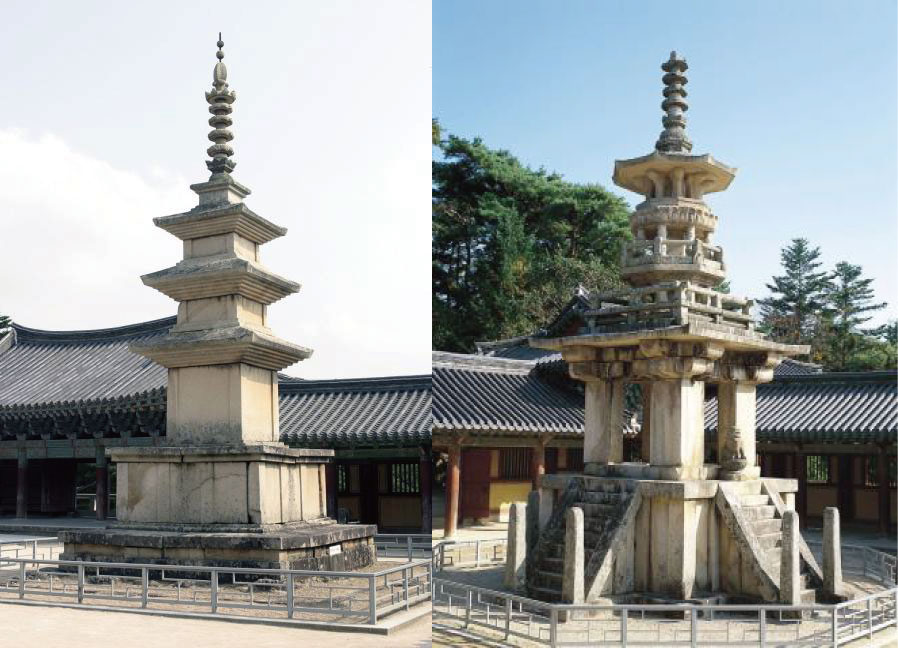
Bulguksa’s most iconic features are the twin stone pagodas standing before the main worship hall – Dabotap (Many Treasures Pagoda) on the west and Seokgatap (Sakyamuni Pagoda) on the east. These pagodas represent one of Korean Buddhist art’s most sophisticated achievements, demonstrating how contrasting design principles can create harmonious pairing that’s more powerful than either structure alone.
Dabotap rises 10.4 meters through elaborate multi-level design featuring square bases, octagonal bodies, circular decorative elements, stone staircases, balustrades, and ornamental details creating visual complexity and rhythmic movement. The pagoda’s name references the Many Treasures Buddha (Prabhutaratna) who appears in the Lotus Sutra alongside Shakyamuni Buddha, representing the eternal nature of Buddhist truth and the countless manifestations of enlightenment.
The pagoda’s design represents one of Korean stone architecture’s most complex achievements. Every level features different geometric forms – squares, octagons, circles – creating visual interest through variation while maintaining overall mathematical harmony. The decorative elements including lion sculptures (now copies, originals in museum) and lotus flower motifs add symbolic richness referencing Buddhist iconography and teaching.
Seokgatap, standing 10.75 meters tall opposite Dabotap, achieves equal sophistication through opposite approach – absolute simplicity and perfect proportion. The three-story pagoda uses standard Korean stone pagoda design refined to mathematical and aesthetic perfection with minimal decorative elements, relying purely on proportion, clean lines, and precise stone cutting. The pagoda’s name references Shakyamuni Buddha (Seokgamoni in Korean), the historical Buddha whose teachings founded Buddhism.
The contrast between complex Dabotap and simple Seokgatap represents fundamental Buddhist philosophical principle – that enlightenment can be reached through multiple paths, some elaborate and decorated with skillful means, others direct and austere. The pagodas standing together demonstrate that these apparently opposite approaches complement rather than contradict each other, both leading to the same ultimate truth.
Mathematical Precision and Golden Ratio
Modern architectural analysis reveals that both pagodas embody sophisticated mathematical principles including ratios approximating the golden ratio (1.618…) that Western architecture “discovered” centuries later. The proportional relationships between base width, body height, roof overhang, and overall height in both pagodas follow mathematical harmonies that create visual satisfaction even in viewers unaware of the underlying mathematics.
Seokgatap’s apparently simple design conceals remarkable precision. Each of the three stories maintains exact proportional relationships with the others, creating visual rhythm that guides the eye upward while maintaining balance and stability. The pagoda’s profile curves subtly inward (entasis) compensating for optical illusions that would make perfectly straight lines appear to bulge outward, demonstrating Silla Dynasty architects’ sophisticated understanding of visual perception.
Dabotap’s complex design requires even more sophisticated mathematical planning to prevent visual chaos. The varying geometric forms – squares, octagons, circles – are positioned and sized according to precise ratios that create harmonious composition despite apparent complexity. The decorative elements are placed with mathematical precision ensuring that asymmetrical details still create balanced overall impression.
The stone cutting precision in both pagodas amazes contemporary engineers. The stones fit together without mortar or metal fasteners, relying purely on precise cutting and gravitational weight for stability that has endured over 1,200 years including earthquakes, weather, and human interference. This technical achievement required master craftsmen working with bronze tools who understood both mathematics and material properties at levels matching or exceeding contemporary expertise.
The Restoration Controversy and Modern Conservation
Both pagodas underwent major restoration in the early 20th century during Japanese colonial period (1910-1945) and again in the 1960s-1970s after Korean independence. These restorations remain somewhat controversial because they involved partial dismantling and reassembly using modern techniques and materials that some argue compromise historical authenticity despite improving structural stability.
During 1960s Seokgatap restoration, workers discovered remarkable artifacts hidden within the pagoda’s base including the world’s oldest known woodblock printed document (Dharani Sutra dated to around 751 CE), demonstrating that Bulguksa pagodas served not just architectural but also religious functions as repositories for sacred texts and relics. This discovery provided crucial evidence for dating the temple and understanding Buddhist practices during the Unified Silla period.
Contemporary conservation efforts focus on non-invasive monitoring and minimal intervention, allowing the pagodas to age naturally while preventing catastrophic failure. The Korean government treats these structures as living heritage requiring careful balance between preservation and allowing natural aging processes. Some original decorative elements including stone lions were removed to museums and replaced with replicas to prevent weather damage while maintaining visual completeness.
Pros of the Twin Pagodas
- Artistic Masterpiece: The pagodas represent Korean Buddhist art at its absolute peak, demonstrating technical skill, aesthetic sophistication, and spiritual depth achieved during Unified Silla golden age.
- Mathematical Sophistication: The underlying mathematical principles and proportional harmonies provide genuine intellectual interest beyond simple aesthetic appreciation.
- Symbolic Depth: The contrasting designs embody Buddhist philosophical principles about multiple paths to enlightenment, adding theological significance to architectural achievement.
- Historical Authenticity: Despite restorations, the pagodas retain most original 8th-century materials and design, providing genuine historical connection across 1,300 years.
- Photographic Interest: The contrasting pagodas standing together create visually compelling composition that photographs beautifully under various lighting conditions.
Cons of the Pagodas
- Restoration Modifications: The 20th-century restorations altered some original details and introduced modern materials, compromising absolute historical purity some visitors expect.
- Access Restrictions: Visitors cannot approach the pagodas closely or touch them, limiting ability to examine stone cutting precision and decorative details at close range.
- Replica Elements: Some visible elements including stone lions are replicas rather than originals, which disappoints visitors seeking complete authenticity.
- Crowd Photography: The pagodas’ fame as Bulguksa’s most iconic features attracts constant tourist photography, making capturing images without people difficult during peak hours.
- Limited Context: Minimal English explanation of the pagodas’ Buddhist symbolism, architectural significance, and historical context leaves international visitors without full appreciation.
STELLA’S LOCAL SECRET
The “Morning Light Symmetry Photography”
Arrive at Bulguksa at opening time on clear mornings to capture the twin pagodas with optimal lighting that reveals their contrasting designs most effectively. Morning sun from the east illuminates Dabotap’s west-facing decorative details while creating dramatic shadows in Seokgatap’s simple geometry, emphasizing the intentional contrast between complex and simple designs.
Best position: Stand at the courtyard’s center point between the two pagodas, shooting with wide-angle lens capturing both structures with main hall visible behind. This composition shows the deliberate pairing and demonstrates how they frame the main worship hall, revealing the architectural planning underlying the temple layout.
Technical settings: Use moderate aperture (f/8-f/11) for depth of field including both pagodas and background hall. Morning’s lower sun angle creates longer shadows emphasizing three-dimensional details in stone carving. Shoot multiple exposures as light changes during the first hour after sunrise, creating different moods and emphases.
Cultural insight: The pagodas’ positioning before the main hall wasn’t random but follows Buddhist symbolic geography representing guardians or markers indicating transition from mundane world (courtyard below) to sacred space (halls above). Understanding this spatial symbolism transforms the pagodas from mere decoration into functional architectural elements guiding worshippers’ physical and spiritual journey.
Cheongungyo and Baegungyo: The Bridge to Enlightenment
Understanding the Stone Bridge Symbolism
The stone bridge staircases connecting lower courtyard to upper hall levels represent Bulguksa’s most philosophically sophisticated architectural elements despite appearing to be merely functional staircases. Cheongungyo (Blue Cloud Bridge) and Baegungyo (White Cloud Bridge) form a dual staircase leading to Daeungjeon (Great Hero Hall), while Yeonhwagyo (Lotus Flower Bridge) and Chilbogyo (Seven Treasures Bridge) lead to Geuknakjeon (Paradise Hall).
These structures aren’t actually bridges in functional sense since they don’t span water or gaps but rather represent symbolic bridges between spiritual realms. The lower staircase represents crossing from earthly human realm (symbolized by blue clouds, still visible from earth) to intermediate spiritual realm (white clouds, higher and purer). Together they symbolize the Buddhist practitioner’s journey from mundane existence through progressive stages of spiritual development toward enlightenment.
The bridges’ design features 33 steps on the Cheongungyo-Baegungyo staircase, representing the 33 steps to enlightenment in Buddhist cosmology. Each step theoretically represents a stage of spiritual development, making the physical act of climbing the stairs a symbolic reenactment of the enlightenment journey. Pilgrims traditionally climbed mindfully, contemplating their spiritual progress with each step upward.
The stone cutting and fitting precision demonstrates remarkable technical achievement for 8th-century construction. Each stone is precisely shaped to fit its specific position without mortar, creating stable structure lasting over 1,200 years despite Korea’s earthquakes, heavy monsoon rains, and temperature extremes. The slight upward curve creates visual grace while serving structural function of distributing weight effectively.
Architectural Innovation and Engineering
Beyond symbolic significance, the bridge staircases represent sophisticated engineering solutions to the temple site’s hillside topography. Rather than flattening the natural landscape – which would have been easier but would violate Buddhist principles of harmonizing with nature – the architects created multi-level terraces connected by these elegant staircases that work with the terrain rather than against it.
The dual-bridge design serves practical functions alongside symbolic purposes. Having two parallel staircases allows separate up and down traffic during crowded ceremonies, preventing congestion and maintaining ritual flow. The division also creates hierarchical access with different bridges potentially designated for different ranks of practitioners during historical periods.
The bridges’ integration with surrounding architecture demonstrates sophisticated spatial planning. The staircases align precisely with hall entrances above and courtyard positions below, creating visual axes that organize the entire temple complex. Standing in the courtyard and looking up the staircases toward the hall entrances creates powerful sense of vertical progression and spiritual aspiration literally built into the architecture.
Modern conservation efforts face challenges maintaining these structures because they function as actual staircases receiving constant foot traffic from thousands of weekly visitors. The stone steps show wear from millions of footfalls over centuries, creating subtle depressions where countless pilgrims and tourists have climbed. Conservators must balance preserving this authentic historical wear against preventing dangerous deterioration.
Climbing Experience and Restrictions
Historically, visitors could climb the original stone bridges, making the symbolic spiritual journey physical reality. However, modern conservation concerns led to access restrictions with most bridges now protected by barriers while nearby concrete or metal staircases provide functional access to upper levels. This preservation decision protects irreplaceable stone structures from further wear but diminishes the experiential and spiritual significance of personally climbing the symbolic enlightenment path.
Some visitors find these restrictions disappointing, feeling robbed of authentic historical experience. The inability to physically climb the original bridges creates psychological and spiritual distance, transforming active participation into passive observation. The modern substitute staircases function practically but lack symbolic resonance and historical authenticity.
However, the restrictions reflect responsible heritage management balancing preservation against access. If thousands of weekly visitors climbed the original stone bridges, accelerated wear would eventually require major restoration or reconstruction that would compromise the structures’ 1,200-year authenticity. The difficult choice between experiential access and long-term preservation favors ensuring that future generations can see authentic 8th-century stone structures even if contemporary visitors cannot physically touch or climb them.
Pros of the Stone Bridges
- Symbolic Depth: The bridges embody Buddhist philosophy about spiritual progress and enlightenment in architectural form, adding profound meaning beyond mere aesthetic beauty.
- Engineering Achievement: The stone cutting precision and structural stability lasting 1,200 years demonstrates Unified Silla technical mastery deserving recognition alongside architectural beauty.
- Visual Grace: The upward curving staircases create elegant lines and proportions that enhance the temple’s overall architectural composition and photographic appeal.
- Spiritual Resonance: For Buddhist practitioners and spiritually-minded visitors, the bridges provide tangible representation of enlightenment journey that connects abstract philosophy to physical experience.
- Historical Authenticity: The bridges retain most original 8th-century stonework, providing genuine historical connection despite some restoration and conservation work.
Cons of the Stone Bridges
- Access Restrictions: Modern barriers preventing climbing the original bridges frustrate visitors who want authentic historical and spiritual experience rather than just visual observation.
- Limited Explanation: Minimal English signage explaining the Buddhist symbolism and 33-step significance leaves international visitors without context to appreciate the bridges’ spiritual meaning.
- Replacement Staircases: The functional modern staircases beside the historical bridges create visual clutter and diminish the contemplative atmosphere the original design intended.
- Wear and Preservation: The visible stone wear from centuries of use creates preservation challenges and raises questions about balancing access against conservation.
- Weather Impact: During rain or snow, the smooth stone steps become slippery and potentially dangerous, requiring closure that disappoints visitors planning specifically to climb them.
STELLA’S LOCAL SECRET
The “Bridge Meditation Practice”
Even though you cannot physically climb the original stone bridges, you can practice a walking meditation on the adjacent modern staircases while contemplating the spiritual journey the historical bridges represent. Climb slowly and mindfully, pausing at each level to observe the stone bridges, reflect on spiritual progress, and appreciate the view changing as you ascend.
Contemplation practice: Count the 33 symbolic steps even while climbing the modern staircase, pausing at each position corresponding to original bridge steps. Reflect on Buddhist teachings about gradual enlightenment, progressive spiritual development, and the long journey from worldly attachment to liberation.
Photography strategy: The viewpoint changes dramatically as you climb, with stone bridges and pagodas revealing different perspectives from each level. Pause at multiple heights to photograph, capturing how the temple’s architectural relationships transform from different elevations. This creates photo series showing spatial progression that mirrors spiritual progression the bridges symbolize.
Respectful approach: Some Korean Buddhist practitioners climb the modern staircases while praying or chanting, treating even the replacement stairs as spiritual practice. Observe respectfully, move aside to allow practitioners space, and appreciate that for Buddhist believers this isn’t historical tourism but active religious practice.
Best Time to Visit and Seasonal Beauty
Spring Cherry Blossoms and New Growth
Spring at Bulguksa, particularly early to mid-April, brings cherry blossoms and azaleas transforming the temple grounds into pastel wonderland. Cherry trees throughout the complex bloom with pink and white flowers creating natural canopy and framing traditional architecture with delicate seasonal beauty. Azaleas add vibrant pinks and purples to hillside areas surrounding the main temple buildings.
Spring also brings fresh green growth after winter’s brown dormancy, with new leaves emerging on trees and ground plants creating sense of renewal that resonates with Buddhist themes of rebirth and continuous cycle of life. The combination of cherry blossoms, azaleas, and fresh greenery makes spring one of Bulguksa’s most photographically beautiful seasons.
However, spring beauty attracts enormous crowds. Cherry blossom season weekends see thousands of Korean and international tourists creating genuinely crowded conditions that diminish contemplative atmosphere. Tour buses fill parking areas, visitor pathways become congested, and finding quiet spots for reflection or unobstructed photography becomes nearly impossible.
Spring weather in Gyeongju can be unpredictable with late-season cold snaps, sudden rain showers, and rapid temperature changes between morning chill and afternoon warmth. Visitors should prepare for variable conditions with layered clothing and rain protection despite generally pleasant spring temperatures.
Summer Green and Monsoon Season
Summer transforms Bulguksa into lush green environment with dense foliage creating natural shade and cooling effect during hot months. The vibrant green provides beautiful contrast with traditional architecture’s earth tones and creates peaceful forest atmosphere. Morning visits during summer offer particularly pleasant experiences before daytime heat peaks.
However, summer means Korea’s monsoon season with heavy rains from late June through July, high humidity, and temperatures often exceeding 30°C. The temple’s hillside location means steep walks become challenging in heat and humidity, and sudden thunderstorms can disrupt visits. Summer is arguably Bulguksa’s least comfortable season despite the beautiful greenery.
Summer brings smaller tourist crowds than spring or autumn, making it easier to find quiet contemplative spaces despite weather challenges. Korean domestic tourism focuses on beach destinations during summer, leaving cultural sites like Bulguksa relatively less crowded for visitors willing to endure the heat and humidity.
Autumn Foliage and Peak Beauty
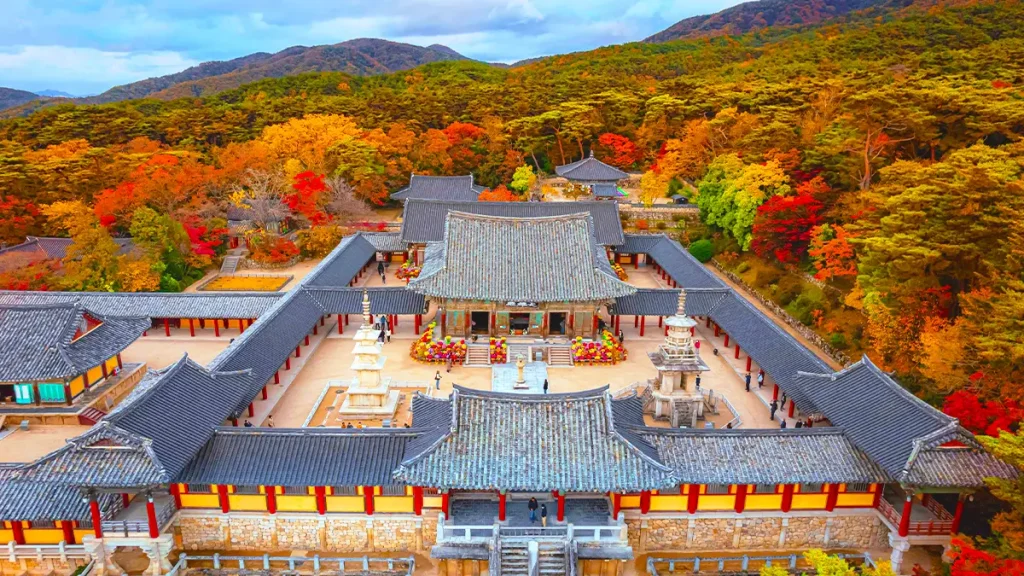
Autumn, particularly mid-October through early November, represents Bulguksa’s most spectacular season when maple and ginkgo trees turn brilliant red, orange, and golden yellow creating dramatic color displays. The autumn foliage against traditional Korean temple architecture creates scenes that look like classical Korean paintings come to life, making this season extraordinarily popular with photographers and nature lovers.
The fall colors progress predictably from higher elevations to lower areas over several weeks, allowing some flexibility in timing visits to catch peak colors. However, precise peak timing varies year to year based on October weather, making advance planning somewhat uncertain.
Autumn weather in Gyeongju is generally reliable with clear skies, comfortable temperatures, and low humidity – ideal conditions for extended outdoor exploration and photography. This perfect weather combined with spectacular foliage makes autumn Bulguksa’s most popular season, bringing crowds rivaling spring cherry blossoms.
Weekend autumn visits during peak foliage period face severe crowding with tour buses filling access roads, parking areas overflowing, and temple pathways packed with visitors. The crowds can make even simple photography challenging and transform contemplative temple into busy tourist attraction.
Winter Solitude and Stark Beauty
Winter at Bulguksa offers completely different aesthetic and experience. The bare trees reveal stone architecture’s underlying forms and proportions obscured by summer’s lush foliage. Fresh snow transforms the temple into monochromatic masterpiece with white snow contrasting dark stone and brown wood, creating minimalist beauty appealing to those who appreciate austere aesthetics.
Winter brings Bulguksa’s smallest crowds with many tourists avoiding outdoor cultural sites during cold months. This solitude allows experiencing the temple closer to how it would have felt during historical periods when pilgrims arrived in small numbers rather than massive tour groups. The contemplative atmosphere the temple was designed to provide emerges most clearly during quiet winter weekdays.
Korean winter is genuinely cold with temperatures regularly below freezing and occasional snow. Visitors must prepare with serious winter clothing including insulated coat, warm layers, hat, and gloves. The outdoor nature of temple touring means extended exposure to cold, making winter visits challenging for those unprepared or uncomfortable in cold weather.
Pros of Strategic Seasonal Planning
- Optimal Beauty: Timing visits for cherry blossoms or autumn colors ensures experiencing Bulguksa during peak seasonal beauty that creates memorable photographic opportunities and visual experiences.
- Weather Comfort: Visiting during spring or autumn provides comfortable temperatures ideal for extended outdoor exploration without summer’s oppressive heat or winter’s severe cold.
- Photography Excellence: Seasonal colors provide natural drama and visual interest that elevates photography from documentary temple shots to genuinely artistic images with distinctive seasonal character.
- Cultural Experience: Visiting during popular seasons means experiencing how Koreans celebrate seasonal beauty at cultural heritage sites, participating in Korean cultural practices around nature appreciation.
Cons of Seasonal Tourism
- Extreme Crowding: Peak seasonal beauty attracts maximum crowds, particularly during spring cherry blossoms and autumn foliage weekends when thousands of visitors overwhelm the temple grounds.
- Inflexible Timing: Committing to specific seasonal visits limits travel date flexibility and creates pressure to visit even if weather is poor during the planned visit dates.
- Higher Costs: Some Gyeongju hotels raise prices during peak autumn foliage and spring cherry blossom seasons, taking advantage of high demand from domestic and international tourists.
- Weather Gambling: Even with careful seasonal planning, specific weather on visit day remains unpredictable – spring rain or autumn overcast can diminish expected seasonal beauty.
STELLA’S LOCAL SECRET
The “Weekday Morning Off-Season Strategy”
Visit Bulguksa on weekday mornings during shoulder seasons – late March before cherry blossoms, June before monsoon, or September before autumn colors peak. These periods offer 70% of peak seasonal beauty with 40% of the crowds, creating nearly optimal experience without the chaos of peak periods.
Why this works: You get pleasant weather, some seasonal color or fresh growth, and manageable crowds allowing actual contemplative experience rather than tourist theme park atmosphere. The tradeoff of slightly less dramatic seasonal beauty is more than compensated by ability to actually appreciate what you’re seeing without fighting crowds.
Timing strategy: Arrive at opening time (usually 7:00 or 7:30 AM depending on season) when only the earliest, most dedicated visitors have arrived. Spend the first hour enjoying nearly private temple experience, then either leave before mid-morning crowds arrive or retreat to quieter sections while casual tourists cluster around famous sites.
Photography advantage: Morning shoulder-season visits combine good light, manageable crowds, and enough seasonal interest for beautiful images without the cliché peak-season shots that thousands of other photographers capture identically. Your photos show Bulguksa more authentically as working Buddhist temple rather than just tourist attraction.
Practical Planning for Your Bulguksa Visit
Getting to Bulguksa from Gyeongju
Bulguksa sits approximately 16 kilometers southeast of central Gyeongju, requiring deliberate transportation planning rather than casual walking from city center accommodations. Multiple transportation options exist with varying cost, convenience, and flexibility tradeoffs.
Public bus from Gyeongju offers the most budget-friendly option. Bus 10 or 11 runs from Gyeongju city center to Bulguksa approximately every 20-30 minutes, taking 35-40 minutes with fare around 1,500 won. The bus stops directly at the temple parking area within easy walking distance of the entrance. This option works well for independent travelers comfortable with Korean bus systems and willing to work around bus schedules.
Taxi from Gyeongju city center costs approximately 15,000-20,000 won one-way, taking 20-25 minutes depending on traffic. Taxis provide door-to-door convenience and flexibility but at significantly higher cost than bus. For groups of 3-4 people, taxi cost per person becomes competitive with bus while offering much greater convenience.
Many visitors rent bicycles in Gyeongju and cycle to Bulguksa as part of exploring the broader Gyeongju historical area. The 16-kilometer ride is manageable for moderately fit cyclists, taking 50-70 minutes depending on pace and weather. This option provides exercise, flexibility, and ability to stop at smaller historical sites along the route. However, the distance and some hills make cycling challenging for less fit visitors or in hot weather.
Tour packages from Gyeongju or even from Seoul and Busan often include Bulguksa as part of day-long itineraries visiting multiple Gyeongju historical sites. These packages handle all transportation and usually include guide services but limit time at each site and may feel rushed for visitors wanting extended contemplative temple experience.
Operating Hours and Admission
Bulguksa operates year-round with seasonal hours. During spring and summer (March-September), the temple opens at 7:00 AM and closes at 6:00 PM. During autumn and winter (October-February), hours shift to 7:30 AM opening and 5:00 PM or 5:30 PM closing depending on month. These hours allow for both early morning visits catching optimal light and afternoon visits for those who prefer later starts.
Admission costs 6,000 won for adults, 4,000 won for teenagers and young adults, and 3,000 won for children. Senior citizens over 65 receive discounted admission. These prices are remarkably reasonable for a UNESCO World Heritage Site, reflecting Korean cultural policy of making heritage accessible rather than treating it as premium tourism product.
The admission ticket includes access to all temple buildings, courtyards, and grounds including the famous pagodas and stone bridges. There are no separate fees for different areas, though some special programs or temple stay experiences require additional payment and advance reservation.
Temple stay programs allow visitors to experience Buddhist monastic life for one or more nights, including meditation practice, temple meals, chanting ceremonies, and interaction with resident monks. These immersive programs provide profound cultural and spiritual experiences far deeper than day visits but require advance reservation, basic physical fitness for daily schedule, and openness to vegetarian meals and early rising.
What to Bring and Wear
Modest clothing is essential for respectful temple visiting. Shoulders should be covered, shorts and skirts should reach at least to knees, and generally conservative dress shows appropriate respect for active religious site. While Bulguksa doesn’t enforce strict dress codes like some temples, visitors dressed inappropriately may feel uncomfortable and draw disapproving looks from Buddhist practitioners.
Comfortable walking shoes are necessary for exploring the hillside temple complex with its stone pathways and stairways. Athletic shoes, walking shoes, or comfortable casual shoes work fine. The temple’s stone surfaces can be slippery when wet, making appropriate footwear important for safety as well as comfort.
For photography enthusiasts, bringing serious camera equipment can be worthwhile given Bulguksa’s exceptional architectural and seasonal beauty. However, heavy professional gear becomes burdensome during extended hillside walking. Consider whether you need all your equipment or if a lighter setup might provide 90% of image quality with 50% of the weight and hassle.
Sun protection during spring and summer includes hat, sunscreen, and sunglasses as portions of the temple grounds have limited shade. Korean sun can be intense despite comfortable temperatures, causing unexpected sunburn during extended outdoor cultural touring.
Water is essential, particularly during summer months. While vending machines and small shops exist near the temple entrance, bringing reusable water bottle ensures hydration during temple exploration without relying on plastic bottles or leaving temple grounds.
Combining Bulguksa with Seokguram Grotto
Seokguram Grotto, another UNESCO World Heritage Site, sits approximately 4 kilometers uphill from Bulguksa, making them natural pair for combined visiting. Many visitors see both sites in a single trip, though this requires careful time management and transportation planning.
The grotto features an 8th-century stone Buddha statue in a man-made cave demonstrating remarkable sculptural artistry and architectural engineering. The Buddha image ranks among Korea’s most celebrated Buddhist artworks, making Seokguram essential visiting for anyone interested in Korean Buddhist culture and art.
Transportation between Bulguksa and Seokguram poses challenges. No direct public bus runs between the sites, requiring either taxi (approximately 8,000-10,000 won one-way), personal vehicle, or strenuous uphill hike along the road (60-90 minutes). Many visitors take taxi from Bulguksa to Seokguram, tour the grotto, then either taxi back to Bulguksa parking area or hike downhill if fitness and time allow.
Allocating time for both sites requires realistic planning. Bulguksa deserves 2-3 hours for thorough appreciation, while Seokguram requires 45-60 minutes minimum. Adding transportation time between sites and breaks, a combined visit typically requires 4-5 hours total.
Pros of Careful Planning
- Optimal Experience: Strategic timing avoiding crowds while catching good weather and light dramatically improves visit quality compared to showing up randomly during peak times.
- Cost Efficiency: Understanding transportation options allows choosing the most cost-effective approach suitable for your budget and group size.
- Combined Efficiency: Planning Bulguksa and Seokguram together maximizes cultural value from one trip to the Gyeongju area, seeing both UNESCO sites efficiently.
- Appropriate Preparation: Knowing what to bring and wear ensures comfortable visit without preventable problems like inappropriate clothing or inadequate sun protection.
Cons of Visit Planning Requirements
- Time Investment: Researching transportation, understanding seasonal patterns, and planning optimal timing requires significant advance preparation that some travelers find burdensome.
- Reduced Spontaneity: Careful planning reduces ability to make spontaneous travel decisions or adjust plans based on weather forecasts or changing interests.
- Transportation Complexity: Reaching Bulguksa requires deliberate transportation arrangements rather than simple walking or convenient subway access, adding logistical complexity.
- Combined Site Challenges: Visiting both Bulguksa and Seokguram in one day creates tight schedules that may feel rushed and prevent thorough appreciation of either site.
STELLA’S LOCAL SECRET
The “Stay in Bulguksa Village Strategy”
Instead of staying in central Gyeongju and commuting to Bulguksa, consider staying in the small village near the temple. Several minbak (homestays) and small hotels offer accommodations within walking distance of the temple, allowing multiple visits at different times of day without transportation hassle.
Why this works: You can visit Bulguksa at opening time, return to accommodation for rest during midday crowds and heat, then revisit in late afternoon for different lighting and smaller crowds. This flexible multiple-visit approach allows experiencing the temple more thoroughly than single rushed visit permits.
Economic advantage: Bulguksa village accommodations often cost less than central Gyeongju hotels while providing more authentic local experience. The village has small restaurants serving traditional Korean food at lower prices than tourist-oriented Gyeongju establishments.
Cultural immersion: Staying near the temple means experiencing local Korean village life, observing resident monks conducting daily rituals, and feeling more connected to the temple as living religious site rather than just tourist attraction. Early morning and evening visits when day-trippers are absent reveal the temple’s authentic character as Buddhist practice venue.
Practical note: Bulguksa village has limited evening entertainment or dining options compared to central Gyeongju. This strategy works best for visitors prioritizing temple experience over urban amenities and willing to embrace quiet village life.
Frequently Asked Questions
Q: How long should I allocate for visiting Bulguksa?
Allocate 2-3 hours minimum for a thorough visit allowing time to explore all major buildings, appreciate the famous pagodas and stone bridges, and spend some contemplative time experiencing the temple’s spiritual atmosphere. If combining with Seokguram Grotto, allocate 4-5 hours total including transportation time between sites.
Q: Can I visit Bulguksa as a day trip from Seoul?
Yes, though it requires very early departure and late return, making for a long day. KTX train from Seoul to Gyeongju takes approximately 2 hours, then additional transportation to Bulguksa. Most visitors prefer staying overnight in Gyeongju to visit Bulguksa and other historical sites without exhausting day-trip schedule.
Q: What’s the best season to visit Bulguksa?
Autumn (mid-October to early November) offers the best combination of spectacular autumn foliage, comfortable weather, and reliable clear skies. Spring cherry blossom season (early-mid April) is equally beautiful but brings larger crowds and less predictable weather. Winter weekdays offer solitude despite cold temperatures.
Q: Is Bulguksa suitable for children?
Bulguksa works well for older children interested in history and culture, but young children may find the temple boring and the uphill walking challenging. The site lacks playground facilities or child-specific attractions, making it better suited to families with teenagers or very culturally curious younger children.
Q: Can I take photos inside Bulguksa?
Photography is generally permitted in outdoor areas including the famous pagodas and stone bridges. However, some indoor halls prohibit photography to protect religious sanctity and artwork. Always look for signage and respect any photography restrictions.
Q: Are there English-speaking guides available?
Professional English-speaking guides can be arranged through tour companies or guide services, though they require advance booking and additional cost. The temple itself doesn’t provide free English guide services, relying instead on limited English signage and audio guide rentals.
Q: Can I wear shorts and tank tops to Bulguksa?
While technically permitted, modest clothing showing respect for the active religious site is strongly recommended. Shoulders should be covered and shorts/skirts should reach at least to knees. Conservative dress shows cultural sensitivity and avoids potential discomfort.
Q: How does Bulguksa compare to Japanese Buddhist temples?
Bulguksa shares some similarities with Japanese temples given both countries’ Buddhist heritage, but Korean temple architecture, symbolic systems, and aesthetic approaches differ significantly. Bulguksa emphasizes mathematical precision and symbolic architecture more than Japanese temples’ typical focus on garden design and architectural asymmetry.
Q: Can I participate in Buddhist ceremonies at Bulguksa?
General visitors can observe ceremonies from respectful distances and participate in temple stay programs offering structured introduction to Buddhist practices. However, formal temple ceremonies are primarily for ordained monks and serious practitioners rather than casual tourists.
Q: Is Bulguksa wheelchair accessible?
Unfortunately, Bulguksa’s hillside location and historical stone staircases create significant accessibility challenges for wheelchair users or those with mobility limitations. Some lower areas are accessible, but reaching the main halls and viewing the famous stone bridges requires climbing stairs.
Conclusion: Encountering Korean Buddhism’s Artistic Peak
You now have comprehensive knowledge to visit Bulguksa Temple with deep understanding of what makes this 1,300-year-old complex one of Korea’s most significant cultural treasures. You’ve learned the full story of how an 8th-century prime minister created this temple to honor parents across multiple lifetimes, embodying Buddhist beliefs about reincarnation and filial piety. You understand the mathematical sophistication and symbolic meaning underlying structures like Dabotap and Seokgatap pagodas that appear deceptively simple.
You know how to time your visit for optimal experience – arriving during quiet winter weekday mornings to experience contemplative atmosphere the temple was designed to provide, or planning for spectacular spring cherry blossoms or autumn foliage while managing the crowds these seasons attract. You’ve gained insight into Korean Buddhist culture and how it differs from other Buddhist traditions through unique architectural and philosophical approaches.
Most importantly, you understand that Bulguksa’s significance lies not just in its UNESCO recognition or architectural achievement but in its continuous functioning as active Buddhist spiritual site where ancient practices continue unbroken for over a millennium. The temple demonstrates that Korean culture successfully maintains connections to sophisticated pre-modern civilization while embracing contemporary development.
Bulguksa awaits in the mountains southeast of Gyeongju. The stone pagodas stand as they have for 1,200 years. The symbolic bridges invite spiritual journey. The monks continue daily practices connecting present to ancient past. Your encounter with Korean Buddhism’s artistic and spiritual peak is about to begin.